Category: Journey of Discovery

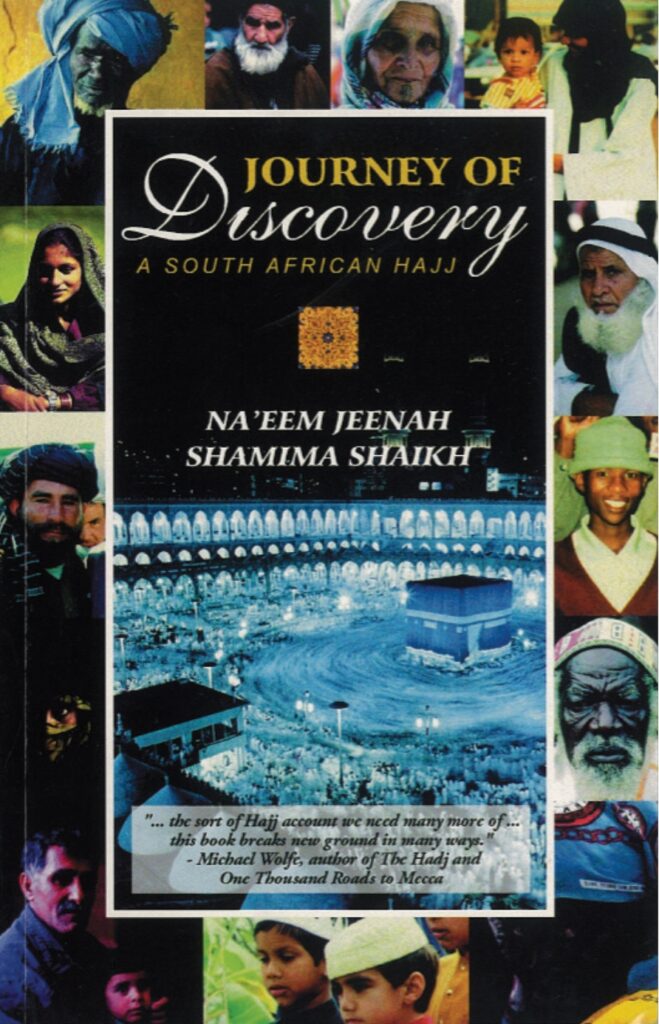
  • Journey of Discovery: A South African Hajj

    By Na’eem Jeenah and Shamima Shaikh

    Published by Full Moon Press (2000), Cape Town, South Africa

    ISBN 0-620-26405-5
    Some comments about the book:

    Michael Wolfe

    Author of: The Hadj: An American’s Pilgrimage to Mecca and

    One Thousand Roads to Mecca: An Anthology of Pilgrim Travel Writing

    This is the sort of Hajj account we need many more of: an honest assessment of an experience shared by millions world-wide, which does not leave out the personal, but rather successfully reminds us that every pilgrim comes from somewhere, from a specific place, a particular family, a politics and a social point of view informed by Islam: in this case, South Africa. And how few books of any kind are written by a husband and wife who enjoy, respect and understand each other! This book breaks new ground in many ways. May other pilgrims follow its fine lead.

    Shamil Jeppie

    University of Cape Town

    I very much liked the whole thing. It is well written, clear, and captivating. The hajj came alive for me like no other description I’ve read before… I still wanted more when I closed the manuscript. Indeed, after each chapter I felt I wanted it to continue. I’m certain many other readers will respond in the same fashion… I thoroughly enjoyed it.

    Tamara Sonn

    College of William and Mary

    This is a unique book, actually groundbreaking in the field of Islamic studies. It is, on its surface, a personal story of a South African couple making their first pilgrimage to Makkah (Hajj) together. The authors are highly intelligent, well educated, slightly sarcastic, but very devout in a way that resonates with the faith of other young people throughout the world. But this book is more than the musings of young professionals on the meaning of a traditional ritual. The authors are South African activists struggling against apartheid and its aftermath. At the same time, Shamima and Na’eem grapple with gender and authority issues within Islam, especially as these issues question their social activism. Their book is therefore a focused story of Muslims committed to social reform and seeking to reconcile their activism with their deeply traditional faith. The story is made all the more poignant knowing that the trip is both the vehicle of spiritual discovery and the couple’s last trip together. Shamima died a few months later, leaving Na’eem to bring up their two young sons and make sense of their journey(s) together. There have been several books published recently on the Islamic pilgrimage: F.E. Peters, The Hajj: The Muslims’ Pilgrimage to Mecca and the Holy Places (Princeton, 1994); I.R. Netton, Seek Knowledge: Thought and Travel in the House of Islam (Curzon, 1966); and most recently, Michael Wolfe, ed., One Thousand Roads to Mecca (Grove, 1997). None of these, however, has the accessibility and personal appeal that Na’eem and Shamima have achieved in their Journey of Discovery. More importantly, none has incorporated the meaning of the pilgrimage into the spiritual and social landscape of Muslim life in the contemporary world, as theirs has. This book is easy to read, yet highly charged intellectually and emotionally, making it a good choice for undergraduate classroom discussion. It is also attractive to a non-specialist readership.

    Laila Al-Marayati

    Chairperson, Muslim Women’s League, USA

    The style is open and inviting and made me feel as if I had accompanied [the] group on its journey. [The] discussion of the significance of the rituals from a spiritual and meaningful Islamic point of view was very enriching. I felt I was seeing things that I already knew in a different and more compelling light. The humor was apparent throughout and is something that is sadly lacking in other books as it seems that we Muslims are unable to laugh at ourselves in general. Several (South African) references were extremely relevant and eye-opening for those of us who were not present during the resistance to apartheid.

    from the ‘Foreword’ by Amina Wadud

    Virginia Commonwealth University

    In sharing their Hajj experience Shamima and Na’eem allow us to witness how Islam as engaged surrender is put into action. For one thing, we are reminded that the struggle goes on at multiple levels. At times we are witnesses to their joy and at other times to their frustrations. We witness small victories and defeats. The Hajj for Na’eem and Shamima is full of the ups and downs of the life journey. In this context Islam as engaged surrender reminds us that we must make our path as we walk it.

    from the biographical chapter by Abdulkader Tayob

    University of Cape Town

    [Shamima] and Na’eem seemed to have discovered different levels of their relationship with God, community and nation. This profundity certainly oozes through the pages of this text as the Hajj brings together their spirituality and their social conscience.

    Read the following reviews of Journey of Discovery:

  • A fine example of “Living Islam”

    By Aslam Fataar & Najwa Nordien

    Published in Al-Qalam, December 2000


    “Have yourself a ‘storied’ Ramadan.” This wish by an American friend to us only became meaningful after we read Na’eem Jeenah and Shamima Shaikh’s book Journey of discovery: A South African Hajj.

    The book is an example of a couple’s active mediation of their Hajj journey’s travails, filtered through their identity as young progressive, somewhat irreverent, and always passionate South African Muslims.

    The book fills an important gap in the religious market. It consists of a number of short stories, written with a compelling flow, and each containing a concise, yet deep message.

    We marvel at this couple’s love of life, of each other and of Allah (SWT), which shine through the pages of the book. They are an example of lives lived differently, and pushed to the limits of their consciences and beyond.

    As committed anti-racists and gender activists, the couple engage with those they meet on hajj, the places they visit, and their acts of worship, in search of greater meaning and inspiration. Hajar is creatively portrayed as “Imamah Hajar” in reference to Muslims following in her footsteps in one of the main rituals of hajj.

    Women praying among men in the precincts of the holy mosque in Makkah are a vindication of the authors’ struggle for absolute equality between men and women. The book succeeds in one fundamental respect: it is neither a text about normative Islam, nor a rule book about how to perform the hajj rituals. It is unambiguously a book about “living Islam”, Islam as an unfinished product, of experiencing and experimenting. The journey towards Islam is as important as the fulfilment of the hajj ritual obligations. Their stories suggest a closer relationship between the ideal and the actual, where the two are brought into conversation with each other, leading to a creative and tasteful exercise of faith. Shamima and Na’eem can proclaim their hajj as truly their very own.

    We encourage a quick and thorough reading of the book. Become inspired, and then write your own stories about your “living Islam”.

  • Faith on the move – Khadija Magardie

    A review of Journey of Discovery: A South African Hajj

    By Khadija Magardie

    Published in Mail & Guardian, 12 January 2001


    Journey of Discovery, the recently published collection of writings by activist couple Na’eem Jeenah and his late wife, Shamima Shaikh, opens with a dedication “for all those fearless enough to say and act according to what they believe is the Truth”. For anyone who has followed the lives and careers of this extraordinary couple, it could not have been more aptly put.

    Their jointly authored book relating their experiences on the Muslim pilgrimage or hajj is less of what Jeenah himself describes as “a how-to book”, than it is a vivid and indeed brave testimony continuing the couple’s tradition of rigorously applying the Qur’anic principle of “standing out firmly for justice”  – at a sometimes heavy cost.

    Recalling the lives of Shaikh and Jeenah, the words of Margaret Thatcher come to mind, who once remarked that her father had installed in her “upright qualities, which entailed a refusal to alter one’s convictions just because others disagreed, or because you became unpopular”.

    Shaikh never got to see the book published – she died of cancer in January 1998, at 37, soon after the pilgrimage. Yet the words of the tenacious young activist speak throughout the book, doing on paper what she had constantly done throughout her relatively short but remarkable life. She spoke out for equal rights and participation for women in all areas of public and religious life, where others would not.

    Earning the derision of many, Shaikh wore her supposedly pejorative name – “That mad Shaikh woman” – like a badge of honour. Whether it was leading groups of women to storm mosques to demand access for women, or battling traditionalists on the airwaves of the radio station she and Jeenah were instrumental in founding, Shaikh’s commitment to racial and gender equality was admirable because, throughout their lives, the odds were never stacked in their favour. But the fruits of her labour live on in the community radio station The Voice, and in the archives of the progressive Muslim newspaper Al-Qalam, which she used to edit.

    Journey of Discoveryis primarily a narration of the pilgrimage to Mecca, a compulsory tenet of the Islamic faith. Its viewpoint – that of a couple so finely tuned to an “equality frequency” – makes it stand out and lends it a South African flavour. The book illustrates, perhaps even painfully, how the racial lens through which South Africans have been conditioned to see the world influences even the simplest issues. The one ugly incident that mars the high spiritual state for the couple, noted in the book, relates to a racially charged incident between a South African pilgrim and a group of dark-skinned pilgrims.

    Shaikh questions the narrow interpretations of women’s role in the mosques back home, when she, a woman, could pray freely and without hindrance in the holiest site of Islam.

    The interest for non-Muslim readers of this book is simple. It is a “spiritual travelogue” that opens a window to a ritual and place that few in fact have the opportunity to be privy to. The words speak for themselves, allowing the reader to “feel” the hajj. The book is simple, easy to read, but with a deeply touching message – that the path to God does not lie in the length of one’s beard, or the number of university degrees one has acquired.

    Shaikh was well-known for disarming those who condemned her audacity at claiming her rightful place in religious life, and asked her to furnish her credentials for her claims.

    “I’m just a housewife,” she would retort.


    Journey of Discovery is published by Full Moon Press and is available from the Muslim Youth Movement of South Africa

    © Mail & Guardian

  • Review; Journey of Discovery by Zulekha Adam-Dinath

    Journey of Discovery: A South African HajjBy Na’eem Jeenah and Shamima Shaikh


    Review published in Al-Qalam, November 2000


    What is unique about these reflections is that they are the experiences of a young activist couple whose identities as man and woman are lived in absolute equality. They become almost indistinguishable as the relationship reaches a plane of spirituality where mutual love and respect elevate them to gender neutrality, if such a spiritual union is at all possible! It is all the more poignant against the backdrop of Apartheid ravages, religious bigotry and personal travails that end the death of one of them.

    The Journey of Discovery is unique in its authorship, the young writers are Muslim South Africans wedged between repression and transformation, committed to challenging injustice in all its guises. Shamima Shaikh and Na’eem Jeenah waded through the difficult times that often saw the potential of marginalised youth thwarted, their dreams constrained and shattered by structured tyranny. The Marxist ideologies and the Black Consciousness Movements were appealing asylums for most young South Africans in the seventies and eighties and the young couple immersed themselves in the student protests and activities. It wasn’t enough. They were too astute, too insightful to undermine the strength of their faith, their belief in the One Compassionate and Merciful God, and it is within the comforting receptacle of Islam that their social identities were burnished.

    It was a bold step, the terrain was made even more hazardous by conservative backlashes and zealous exclusions and the misconceptions that abounded both within and outside the community. The Iranian revolution had shifted the focus to a wider screen and Muslims throughout the diaspora began to stir, much to the chagrin of dominant political and religious interests. This did not deter a vulnerable group of young Muslims in whose company Shamima and Na’eem sought to define their spirituality, God consciousness and social action.

    In recent years many dissertations have been written about Muslims, some have sought to understand the position of Muslim women, a pitied and fashionable cause celebre for radical feminists who have made mileage out of every conceivable feature of Islamic life which seems anathema to their perceptions of liberation. Muslim writers, including Fatima Mernissi, Rana Kabbani and Nawal El Saadawi have retaliated in some measure to restore authenticity and dignity to the debate. The Journey of Discovery is the first work emanating from a uniquely South African experience; that it is written by a man and a woman in synergy lends itself to greater profundity than was perhaps intended.

    The Hajj, the pilgrimage to Mecca, symbolises the multiple levels of the Journey of Discovery, but it is by no means a ‘how-to book’, nor is it austere and staid in its style as most religious works tend to be. This account of the Hajj is personal and warm in its inclusion of the reader, intimate details delightfully become shared experiences as the couple discovers the joys of the rituals of performing their obligatory prayers. The immense thrill of being on the plains of Arafat among millions of other Muslims, in the heat of the Arabian sun and feeling an unbearable closeness to each other and God are treasured moments that make this account so different. The encounters, both spiritual and real are recounted within the context of the Qur’an and Ahadith , the utterances of the Prophet Muhammad (pbuh), the conversational short vignettes illuminate the subject with undertones of humour and sarcasm and some tongue-in-cheek observations of truly South African Muslim characteristics. It is a light and luminous text that even when dealing with the sad facts of Shamima’s illness and passing embody a spirit of surrender to the will of the Creator.

    If there is a pulse that resonates throughout the book then it must be Shamima’s declaration that “I have struggled, I have exhausted myself because that is what I was created for, just as my ‘Imamah’ Hajar was created for. I can tell my Creator that I have striven.” Ultimately the Hajj – and life – is about struggle. Shamima’s life was about struggle. In the words of Amina Wadud, the eminent Muslim woman scholar, it was an ‘engaged struggle’ and Shamima was never afraid of engaging the forces that oppressed. She challenged the patriarchal structures that distorted the equality given to women by Islam, she forced men to open the mosques to women, she encouraged women to relook at the sciptures and revalue themselves as equal in the eyes of Allah, she set examples by initiating discussions around Muslim Personal Law and its inclusion in the Constitution, sounding the warning bells that if women did not insinuate equal participation at all levels of its formation much would be left to the male religious bodies and women would not be consulted and their equality imperiled.

    Shamima’s emulation of Hajar, who ran between the hills of Safa and Marwa searching for water for her starving baby, is nothing short of a miracle. She believed that the striving is an end in itself and that struggle does not necessarily end in reward, but is a journey of the soul in its quest for Allah. The events recounted in the Journey of Discovery open a window to the brilliant and visionary mind of this gender warrior who still has a profound influence on women who have had the privilege of knowing her. Like Hajar, her struggle will not have been in vain as a younger generation of Muslim women strive to assert their equality and proudly reaffirm their faith knowing that women in Islam are unconditionally equal. If the feminist agenda is to change the world, then Shamima Shaikh was a Muslim feminist – and that is not a contradiction.

     
  • Journey of Discovery: A South African Hajj

    Journey of Discovery: A South African Hajj

    By Na’eem Jeenah and Shamima Shaikh


    Published by Full Moon Press (2000), Cape Town, South Africa

    ISBN 0-620-26405-5


    Order this unique book today through the publishers in South Africa (email bookorders at amec.org.za – replacing “at” with “@”) or through Amazon.com!


    Some comments about the book:

    Michael Wolfe

    Author of: The Hadj: An American’s Pilgrimage to Mecca and

    One Thousand Roads to Mecca: An Anthology of Pilgrim Travel Writing

    This is the sort of Hajj account we need many more of: an honest assessment of an experience shared by millions world-wide, which does not leave out the personal, but rather successfully reminds us that every pilgrim comes from somewhere, from a specific place, a particular family, a politics and a social point of view informed by Islam: in this case, South Africa. And how few books of any kind are written by a husband and wife who enjoy, respect and understand each other! This book breaks new ground in many ways. May other pilgrims follow its fine lead.


    Shamil Jeppie

    University of Cape Town

    I very much liked the whole thing. It is well written, clear, and captivating. The hajj came alive for me like no other description I’ve read before… I still wanted more when I closed the manuscript. Indeed, after each chapter I felt I wanted it to continue. I’m certain many other readers will respond in the same fashion… I thoroughly enjoyed it.


    Tamara SonnThe College of William and Mary


    This is a unique book, actually groundbreaking in the field of Islamic studies. It is, on its surface, a personal story of a South African couple making their first pilgrimage to Makkah (Hajj) together. The authors are highly intelligent, well educated, slightly sarcastic, but very devout in a way that resonates with the faith of other young people throughout the world. But this book is more than the musings of young professionals on the meaning of a traditional ritual. The authors are South African activists struggling against apartheid and its aftermath. At the same time, Shamima and Na’eem grapple with gender and authority issues within Islam, especially as these issues question their social activism. Their book is therefore a focused story of Muslims committed to social reform and seeking to reconcile their activism with their deeply traditional faith. The story is made all the more poignant knowing that the trip is both the vehicle of spiritual discovery and the couple’s last trip together. Shamima died a few months later, leaving Na’eem to bring up their two young sons and make sense of their journey(s) together. There have been several books published recently on the Islamic pilgrimage: F.E. Peters, The Hajj: The Muslims’ Pilgrimage to Mecca and the Holy Places (Princeton, 1994); I.R. Netton, Seek Knowledge: Thought and Travel in the House of Islam (Curzon, 1966); and most recently, Michael Wolfe, ed., One Thousand Roads to Mecca (Grove, 1997). None of these, however, has the accessibility and personal appeal that Na’eem and Shamima have achieved in their Journey of Discovery. More importantly, none has incorporated the meaning of the pilgrimage into the spiritual and social landscape of Muslim life in the contemporary world, as theirs has. This book is easy to read, yet highly charged intellectually and emotionally, making it a good choice for undergraduate classroom discussion. It is also attractive to a non-specialist readership.


    Laila Al-Marayati

    Chairperson, Muslim Women’s League, USA

    The style is open and inviting and made me feel as if I had accompanied [the] group on its journey. [The] discussion of the significance of the rituals from a spiritual and meaningful Islamic point of view was very enriching. I felt I was seeing things that I already knew in a different and more compelling light. The humor was apparent throughout and is something that is sadly lacking in other books as it seems that we Muslims are unable to laugh at ourselves in general. Several (South African) references were extremely relevant and eye-opening for those of us who were not present during the resistance to apartheid.


    from the ‘Foreword’ by Amina Wadud

    Virginia Commonwealth University

    In sharing their Hajj experience Shamima and Na’eem allow us to witness how Islam as engaged surrender is put into action. For one thing, we are reminded that the struggle goes on at multiple levels. At times we are witnesses to their joy and at other times to their frustrations. We witness small victories and defeats. The Hajj for Na’eem and Shamima is full of the ups and downs of the life journey. In this context Islam as engaged surrender reminds us that we must make our path as we walk it.


    from the biographical chapter by Abdulkader Tayob

    University of Cape Town

    [Shamima] and Na’eem seemed to have discovered different levels of their relationship with God, community and nation. This profundity certainly oozes through the pages of this text as the Hajj brings together their spirituality and their social conscience.


    Read the following reviews of Journey of Discovery:

    • Review by Zulekha Adam-Dinath – al-Qalam, November 2000
    • Faith on the move, Review by Khadija Magardie, Mail & Guardian, 12 January 2001
    • A Fine Example of “Living Islam”, Review by Aslam Fataar & Najwa Nordien, al-Qalam, December 2000