Category: Shamima’s Articles


This is a selection of articles written by Shamima Shaikh.
Most of her articles published in Al-Qalam (the Muslim community newspaper of which she was editor for three years) are not included here.

  • 23rd Street Women’s Jamaah statement

    This was a pamphlet authored by Shamima and distributed at Johannesburg’s 23rd Street Mosque on the 28th night of Ramadan in 1993. The pamphlet has a history, of course, and you may read about that in Shamima’s Profile or in “Death of a Muslim Joan of Arc”


    In the Name of Allah, Most Gracious, The Dispenser of Grace

    Statement by the 23rd Street Mosque Women’s Jamaah

    (28 Ramadan 1413)

    Muslim women in the Transvaal have been for long denied our right of performing our salah in jamaah. We were thus very grateful to the trustees of the 23rd Street Mosque last year when special facilities were provided for us on the 27th Ramadan.

    This year Muslim women have been performing salah at this mosque on this level since the 1st Ramadan. We exercised great tolerance, especially on the first night, just so that we could fulfil this Sunnah of our Nabi Muhammad (saw). On the first night we were shouted at, intimidated, and some women’s salah was broken, after which they left to perform salah at another mosque over five kilometres from here. We did not expect such behaviour from a trustee of a mosque. Yet we continued attending salah here, and this practice enhanced our appreciation of Ramadan.

    Last night we were shocked and disappointed that after performing tarawih here for 26 nights we were forced to offer our salah behind the mosque in a marquee with wet mats. There were about 150 women, and there would have been enough space here for all of us.

    What hurts us is that while we had performed salah here for the whole month, and many of us arrived at 7:30pm last night, men that arrived late – many of whom had possibly not regularly attended the tarawih – got preferential treatment and performed their salah in the area we had, we believe, earned through our perseverance. Why were the late men not directed to the marquee?

    It is about time that our community, especially the men, begins educating itself about issues that are crucial to our lives and survival as a community. Women and children are not second-class citizens to be denied access to mosques, to be hushed up whenever we begin talking, and to be shunted around at the whims of men.

    It is the Grace of Allah that liberated women through Islam 1400 years ago. It was this expression of Allah’s Grace that the Prophet Muhammad (saw) ordered that women not be prevented from attending mosques.

    We will not depend on the grace of some men above that of Allah. We have performed salah here for this month and will continue to perform salah here in the months to come. This mosque does not belong to a committee, or to the men in our community; it belongs to the whole community: children, women and men.

    Women’s attendance at this mosque for all salawat will, insha Allah, become a regular feature!

  • Woman’s role in contemporary society

    Presented at Rhodes University, Grahamstown, South Africa, on the occasion of the Islamic Week organised by the Muslim Students Association in 1994


    I would like to thank the Muslim Students Association for giving me this opportunity to speak with you on the issue of women which is close to my heart and which is, I believe, one of the biggest challenges facing us today as we move towards a better and just society.

    The role of woman, her position and status in society, and her nature have been issues of debate and discussion informed by religion, tradition and culture, misogyny, feminism and – many times – downright ignorance and bigotry.

    I am a Muslim and Muslims seek guidance from Allah through his book, the Qur’an, and His messenger Mohammed (pbuh). Muslims believe that the word of Allah is supreme and takes precedence over all traditions cultures.

    The Muslim Youth Movement in its struggle towards realising its goals of establishing a just order based on the Divine Will and promoting the values and principles of Islam felt that the area of gender needed redressing. We therefore established the Gender Desk.

    As the head of the MYM Gender Desk and on the many campaigns we undertake – like getting women to the mosques, struggling for a just Muslim Family Law system or simply insisting that the woman’s voice be heard – I am often asked by people who are not Muslim why I do what I do; why struggle for the rights of women –  and particularly Muslim women. What happened in my past that drove me to this?

    The answer is simple: we respond to the injunction of the Qur’an to “enjoin what is right and forbid what is wrong”, as we did when faced with the terrible injustices of apartheid and oppression on the basis of race and class.

    In discussing the role of women in contemporary society I have divided my talk into three parts:

    1.       The perceptions of woman within contemporary Muslim societies.

    2.       The status, position and role of woman in the Qur’an and in early Islam from where we derive our aspirations.

    3.       Some of the challenges facing us in contemporary society – more specifically, in South Africa.

    You might have heard at some time or the other that Islam teaches that women are “inferior” and “unequal” to men. Women are described as weak, inferior, inherently evil (it is the nature of woman to promote fitnah (mischief)), we have deficient intellectual capabilities and are spiritually lacking. Furthermore, these evaluations have been used to claim that women are unsuitable for performing certain tasks, or for functioning in some ways in society.

    Thus women are barred from mosques and excluded from other Muslim institutions. The “intermingling of the sexes” is frowned upon on the basis that women create fitnah. The Muslim identity of a woman is restricted and limited to her dress code.

    Specific functions and roles have been attributed to each sex; the function of woman is often confined to her reproductive ability. It is known that her primary function is to be mother and wife. And that she would be lacking in her Islamic duty if she in any way did not fulfil this role in accordance with how society defines it.

    Since it is the responsibility of males to provide for females, women are liberated from all social, political and economic obligations. They are freed from all these burdens so they can enjoy the joys of housework and child-bearing and caring. And this is regarded as the special status that Islam has accorded woman, thus liberating her from oppression and suppression over 1400 years ago.

    Some traditionalists are of the opinion that “according to strict Islamic injunctions, it is not obligatory for a woman to cook food for her husband or children or wash their clothes or even suckle the infants. A woman may refuse to do all these things without this being made ground for legal complaint against her. If she undertakes these duties it is out of sheer grace.” Nevertheless, they stress that man and woman’s roles are complementary and the most important role the women plays is in the family unit.

    The same traditionalists also believe that her primary role is that of a mother and wife and that she needs not venture from the home and the darkest corners of her home are best for her. They also limit her freedom to exercise her will and choice.

    It is ironical that all of them claim that Islam liberated women 1400 years ago. They claim that Islam gave women the right to equal education and civil and economic rights, but at the end of their analysis they come to the conclusion that a woman’s place is in her husband’s home and that she should be obedient to him and the male elite.

    How on earth can she enjoy any liberty if she lacks knowledge, is confined to her home and has minimal control over her life.

    We need to ask: Are these the teachings of Islam or have they been concocted by some people in order to maintain control over a sector of society so that they alone can benefit optimally. It is our duty as Muslims to refresh people’s memories and look to our Glorious Qur’an and our glorious past. Let us look at the status and position and role of women in Qur’an and early Islam.

    The fundamental principle of Islam is Tauhid – the unity of the human race under the sovereignty of the One and Only, Universal Divine Allah. Islam’s message of peace affirms the equality of all human beings, and rejects all discrimination on the basis of race, class and gender.

    Yes, Allah is the Sovereign and we succumb to Him and put aside our preferences, prejudices, and traditions and culture which are secondary to Allah’s injunctions.

    The Qur’an declares the absolute moral and spiritual equality of men and women.

    “For Muslim men and Muslim women, for believing men and believing women, for devout men and devout women, for true men and true women, for men and women who are patient and constant, for men and women who humble themselves, for men and women who give in charity, for men and women who fast (and deny themselves), for men and women who guard their chastity, and for men and women who engage much in Allah’s praise, for them has Allah prepared forgiveness and great reward.”(Sura 33:35)

    This passage makes a clear statement about the absolute equality of the human moral condition and identical spiritual and moral obligations placed on all individuals regardless of sex. Incidentally, this is one of the passages that addresses women directly. It is related that the women asked the Prophet Muhammad (pbuh) about why the Qur’an addressed only men when women too accepted God and His prophet. This question occasioned the revelation of the Qur’anic verses explicitly addressing women as well as men – a response that unequivocally shows Muhammad’s (pbuh) and Allah’s readiness to hear women. Thereafter the Qur’an explicitly addressed women a number of times.

    I would like to read Sura 3:195 to you:

    “And their Lord has accepted of them, and answered them: ‘Never will I suffer to be lost the work of any of you, male or female. You are members, one of another: Those who have left their homes, or been driven out therefrom, or suffered harm in My Cause, or fought or been slain, verily, I will blot out from them their iniquities, and admit them into gardens with rivers flowing beneath. A reward from the presence of Allah, and from His presence is the best of rewards.’”

    Allah clearly tells us here that we are members of one and the same human race, and therefore equal to one another.

    We read in the Qur’an that taqwa (God-consciousness) is the only distinguishing factor between human beings.

    “O humankind! We created you from a single (pair of a) male and a female, and made you into nations and tribes, that you may know each other (not that you may despise each other). Verily the most honoured of you in the sight of Allah is the most righteous (or God-conscious) of you. And Allah has full knowledge and is well acquainted (with all things).”(Sura 49:13)

    And taqwa – “God consciousness” – is definitely not determined by gender!

    Another interesting fact about women in the Qur’an is that Allah relates instances when woman received wahy (revelation). Oftentime the assertion is made that there has never been a female prophet. To that I say that there is no conclusive evidence that there did not exist a woman prophet. And yes, women have received wahy. Allah sent a messenger who carried Allah’s message to Mary (pbuh):

    “She placed a screen (to screen herself) from them; then We sent her our angel, and he appeared before her as a man in all respects. She said: ‘I seek refuge in The Most Gracious from you: (come not near) if you are conscious of Allah.’ He said: ‘No, I am only a messenger from your Lord, (to announce) to you the gift of a holy son.’”  (Sura 19:17-19)

    Allah also “spoke” to the mother of Musa:

    “And We revealed to Musa’s mother, saying: ‘Give him suck, then when you fear for him, cast him into the river and do not fear nor grieve; surely We will bring him back to you and make him one of the messengers.’”(Sura 28:7).

    And, in the Qur’an we read the story of Bilqis, the Queen of Sheba. Most Muslims hold leadership as improper for women. The Qur’an uses no terms to imply that leadership is inappropriate for a woman. On the contrary, the Qur’anic story of Bilqis celebrates both her political and religious practices:

    “But the Hoopoe tarried not far: he (came up and) said: ‘I have compassed (territory) which you have not compassed, and I have come to you from Sheba with tidings true. I found (there) a woman ruling over them and provided with every requisite; and she has a magnificent throne…”(Sura 27:22-23).

    These verses and the verses following them  tell us of a wise woman; a woman who recognises the goodness in the Propeht Sulaiman (Solomon) just from his letter to her; a woman who rules her people through consultation; a woman who readily recognises and accepts the Truth when Solomon presents it to her.

    What is interesting is that Allah, The Most Wise, has not specified any particular role for all men or all women. The Qur’an does not propose or support a singular role or single definition of a set of roles, exclusively, for each gender across every culture.

    This thus allows individuals the freedom to decide on their functions and roles best suited to their contexts. This must, of course, be done by maintaining fairness and equality through mutual consultation, mercy, consideration and compassion between those affected by the decision.

    Women do have a special and exclusive function; and that is procreation. The Qur’an elevates this special function in Sura 4 Verse 1:

    “O humankind! Reverence your Guardian-Lord… reverence Allah, through whom you demand your mutual (rights), and (reverence) the wombs (that bore you).”

    Another aspect that engenders the equal worth of individuals is that the Qur’an does not set value for particular deeds between men and women. Note verse 195 in Sura 3:

    “Never will I suffer to be lost the work of any of you, male or female. You are members, one of another

    In contemporary society this is not so. Much more value is attached to the work that men do. Domestic work is not less of a good deed than going out of the house to work. I believe that there is space in Islam to actually attach monetary value to domestic work done by  wives. Indeed, some classical scholars have stated that women should be paid even for breastfeeding their own children! And if the criteria for valuing any function is monetary value then we should insist that all these functions should also have monetary values attached to them.


    History

    Let us now take a step back into our history and look at the various roles our sheroes played in the societies they lived in. I admit I will be focusing on and emphasising the active and assertive roles they played. We have been taught well about what is traditionally considered to be pious about our early Muslim sisters. But what about the other roles they played?

    Women were actively involved in warfare.

    Umm ‘Umara was known for her effectiveness with weapons. The Prophet (pbuh) commented that she was better than many men. Umm ‘Umara fought in many battles and she lost her hand in one of them.

    Umm Hakim single handedly disposed of seven Byzantine soldiers in the battle of Marj al- Saffar.

    In one expedition against a Persian seaport the women, led by Azdah bint al-Harith turned their veils into flags, marching in martial array to the battlefield. They were mistaken for fresh reinforcements, which struck fear into the hearts of the enemy, and this contributed – at a critical moment – to the victory of the Muslims.


    Religion

    Women of the first Muslim community attended the mosque, took part in religious services on feast days, and listened to Muhammad’s (pbuh) discourses. They were not just passive listeners and docile followers, but actively participated in discussion and questioned, confronted and challenged.

    This practice continued even in ‘Umar’s time – when he was caliph. It is reported that when ‘Umar attempted to limit the dowry in a khutbah in the mosque, a woman challenged his ruling and ‘Umar conceded that “the woman is correct and ‘Umar is wrong”.

    Talking about the mighty ‘Umar, strong-headed and strong-willed… He never forbade his own wife to attend the mosque because he knew that this was a betrayal of the Prophet’s teaching. In fact, he tried some dubious means to discourage her. He once hid in an alley and frightened her to illustrate the danger of women being harassed by the hypocrites while they were going to mosque. He was not successful; his wife continued on her way to the mosque!

    Woman participated in political activities.

    When Makkah was recaptured by the Muslims (Fath Makkah) many woman came to give their allegiance to Islam. They refused to offer their allegiance to ‘Umar and insisted that they wanted to give it to the Prophet (pbuh) himself. The Prophet conceded and this was at a public assembly of men and women.

    Women like Asma bint Abu Bakr were active in the workforce. She shared the responsibility of supporting her family with her husband by working away from her home.

    Women were given the responsibility of running the affairs of state. A woman – Shifa bint ‘abd Allah – was appointed controller of the market of Madinah by the Prophet. She was reappointed by ‘Umar when he became caliph.

    The Prophet left it in the hands of his wife Umm Salamah to advise the Muslims to forgo the haj and to rather sign the treaty of Hudaibiyya.

    ‘Aisha, the prophet’s wife, was a reporter of many of the Prophet’s traditions. She also addressed the congregation at the mosque and led an army in battle.

    In the private domain women also exercised their rights.

    They enjoyed the freedom of stipulating their demands in their marriage contract. An illustrious example is the story of Sukayna, the great-grand-daughter of the Prophet, daughter of Husayn. In her marriage contract she stipulated that she would not obey her husband and denied her husbands had the right to practise polygamy. She brought a case against one of her husbands who had violated her rule of monogamy. The judge was obliged to hear her case.

    Yet when we attempt to assert ourselves as Muslim women we are accused of being influenced by the West, and attempting to cause divisions and putting Muslims and Islam to disrepute.

    The renowned author Fatima Mernissi, says in Women and Islam that such a person is “one who misunderstands his own cultural heritage. The vast and inspiring records of Muslim history so brilliantly completed for us by scholars such as Ibn Hisham, Ibn Hajar, Ibn Sa’ad and Tabari speak to the contrary.

    “We Muslim women can walk into the modern world with pride, knowing that the quest for dignity, democracy, and human rights, for full participation in the political and social affairs of our country , stems from no imported Western values, but is a true part of Muslim tradition.

    “Women fled aristocratic tribal Mecca by the thousands to enter Medina, the Prophet’s city in the 7th century, because Islam promised equality and dignity for all, for men and women, masters and servants. Every woman who came to Medina when the Prophet was the political leader of the Muslims could gain access to full citizenship, the status of sahabi, companion of the Prophet. Muslims can take pride that in their language they have the feminine of that word, sahabiyat, women who enjoyed the right to enter into the councils of the Muslim umma, to speak freely to its Prophet-leader, to dispute with men, to fight for their happiness, and to be involved in the management of military and political affairs. The evidence is there in the works of religious  history, in the biographical details of sahabiyyat by the thousands who built Muslim society side by side with their male counterparts.”

    Lastly, let us look at some of the challenges facing us as we aspire towards the realisation of our goals of justice and a better society.

    (Unfortunately, this section was not completed by Shamima in the paper version we have, although she did present it at the meeting. And no recording exists to be able to complete it. Thus we simply reproduce here the points in her notes. – editor)

    1.       Addressing the misrepresentation and misemphasis in Islam (which is contrary to what we see in the Qur’an and in History).

    2.       Realising what the position and roles of men and women are.

    3.       Addressing the problems of gender relationships in Muslim communities and outside, gender imbalances.

    4.       Muslim Personal Law

    5.       Muslim women and the Muslim public domain.

    6.       Campaigns.


  • Denying women access to the ‘Main Space’ – A Betrayal of the Prophet

    Presented to the Jamaat Khana Committee of the University of the Witwatersrand – 1995. Shamima was a ‘community member’ of the committee which was negotiating with the university administration for a new Mosque complex and participating in decisions regarding the design of the complex. She argued for women to be accommodated in the ‘main space’ of the mosque.


    An ‘Ignorance’ that’s frightening

    I was prompted to put together these few thoughts after a meeting with a group of architects (who are also popular mosque designers in South Africa) and students who presented their proposals for the WITS mosque. The architects expressed their certainty as to where a woman may be located in a mosque, saying that any other accommodation was bid’ah (innovation). A young student presenting his design said women and men reading alongside was unacceptable; they had to be completely separated (he said that women should be accommodated in a gallery). His other assumption was that men at WITS could not control their libidos.

    It was their certainty that their beliefs and perspectives were actually the Prophetic tradition and that anything else was bid’ah, that I found frightening. I was in no doubt about the sincerity and love these men have for the Prophet (pbuh). It is because of this and my own love for Islam and the Prophet (pbuh) that I feel the need to inform them about what I’ve come to learn about women and the space they occupied in the Prophet’s mosque.

    Women’s Space in the Prophet’s Mosque

    Women occupied the back rows of the Prophet’s mosque; where they could be seen and heard by the rest of the congregation. (Remember that the Prophet’s mosque was fairly small.)

    Ibn Abaas (ra) said: “Once the Prophet came out (for the ‘Id prayers) as if I were just observing him waving to the people to sit down. He then, accompanied by Bilal, came crossing the rows till he reached the women. He recited verse 12 of chapter 60 to them and asked: ‘O ladies, are you fulfilling your covenant?’ None except one woman said ‘Yes’. The Prophet then said: ‘Then give sadaqah.’ Bilal (ra) then spread his garment and said ‘Keep on giving alms’. 1


    Access to the Imam

    Direct contact between the Prophet, as the imam who led the prayers, and those who attended the prayers seems to have been an important element in the Friday khutba:

    “. . . On Friday he (the Prophet) preached the khutba leaning on a staff. . .. And the people were in front of him, their faces raised toward him, they listened as they watched him. . . .”²

    The idea that the mosque is a privileged place, the collective space where the leader debates with all the members of the community before making decisions, is the key idea of Islam which today is presented to us as the bastion of despotism. Everything passed through the mosque which became the school for teaching new converts how to do the ritual prayer, the principles of lslam, how to behave towards others in places of worship and elsewhere. Was it fitting to come armed or not? Could one do buying and selling there (the Prophet and his Makkan supporters were originally merchants)? Could one keep prisoners of war in the mosque courtyard (to keep better watch on them) or not?³

    The mosque was a space where dialogue between the leader and the people could take place. The apparently simple decision to install a mimbar in the mosque was treated by the Prophet as a matter that concerned all Muslims:

    The Prophet used to say the Friday prayers standing, leaning against a palm trunk. One day he announced that standing made him tired. Tamim al-Dari answered: ‘Why not build a pulpit like I have seen in Syria?’ The Prophet asked their advice on the question, and they agreed to the suggestion.(4)

    A Madinah carpenter cut a tree and built a pulpit with a seat and two steps up to it.

    Other versions say that the Prophet was urged to take his place on the mimbar at the time of prayer so that he could be seen by everybody, because in a few months the number of Muslims had grown considerably, and this seemed a more plausible reason than fatigue. The Prophet was only 54 years old at the time of the Hijra and was in the prime of life.


    From access to denial of access

    In the Kitab al-Jum’a (Book of Friday) of Imam Bhukhari (d. 256H),(5) who wrote two centuries after the death of the Prophet (pbuh), he quotes the hadith:

    “Do not forbid the mosques of Allah to the women of Allah.”

    A half-century later (300H), Imam Nasa’i, wrote his al-Sunan. In his chapter on al-masjid, he gives specifications for the rows between men and women: how crowded they may be and how far from each other.

    He states that a man has no right to forbid his wife to go to the mosque. He quotes the Prophet:

    “When a woman asks authorisation from one of you to go to the mosque, let him grant it to her.”(6)

    Ibn al-Jawzi (d. 597H), wrote a book on the laws that govern women in Islam and devoted his chapter 24 to ‘Women’s Friday Service’. He had to acknowledge that they had a right to the service since the hadith on the subject was incontrovertible. However he raises four issues:

    On the question of rows he said ‘the prayers of men who are seated behind women are worthless.’(7) It often happened that men came to the mosque late and were blocked by the rows of women. It is very easy to imagine the fatal next step: ban women from the mosque, since the mere presence of women risked creating a problem.

    Ibn al-Jawzi than asks a question which in itself contains a betrayal of the ancient texts: ‘Is it permitted for women to go to the mosque?’ And his answer: ‘If she fears disturbing men’s minds, it is better for her to pray at home.’(8)

    He cites Bukhari’s key hadith in which the Prophet stresses that the mosques of Allah are not forbidden to women. He concludes by saying that ‘the Friday service is not a duty for women’.(9) And, ‘A woman should try to avoid going out as much as she can.’(10)

    But it is in reading modern authors like Muhammad Sadiq al-Qannuji, the twentieth-century Indian scholar (d. 1308H), that one notes the institutionalisation of the exclusion of women from such a crucial place as a mosque. In his chapter on “What has been said on the fact that the Friday sermon is not a duty for women”, he brings out a dubious hadith which says: “The Friday service is a duty for all Muslims, with four exceptions: slaves, women, children, and the ill.”(11)

    We are certainly a long way from the Prophet’s mosque, open to all, welcoming all those interested in Islam, including women. The mosque now suffers a betrayal of Muhammad’s (pbuh) ideal community: women are declared strangers to the place of worship. Women, who had the privilege of access to the mosque as sahabiyyaat, companions of the Prophet, very quickly became polluting, evil beings.


    Sexual men and invisible women

    The premise that women ‘distract’ men from their spiritual endeavours and that they stimulate sexual urges rests on a certain understanding of what it means to be human, and a certain understanding of what constitutes maleness and femaleness.

    This argument operates from the premise that our focus of control, and our focus of self as human beings, as Muslims, is outside ourselves, and that men have weak inner centres since, upon seeing and listening to women, they are overcome by irresistible uncontrollable sexual urges. By such reasoning we imply that man are incapable of taking moral responsibility for their behaviour and relations.

    The solution is to manipulate the external environment – women must be invisible – to keep men’s responses in check. This raises important questions: What does this say about man’s capacity to take full responsibility for his spirituality? On what understanding of humanity are these arguments based?

    In order that we believing men and believing women, God-conscious men and God-conscious women, can reclaim our full humanity, reclaim our Islam, we need to revolutionise our categories of maleness and femaleness. We must reject the idea of uncontrollable male sexuality and evil women.

    Allah says in the Qur’an: “The Believers, men and women, are protectors one of another: they enjoin what is just, and forbid what is evil: they observe regular prayers, practice regular charity, and obey Allah and His apostle. On them will Allah pour His mercy: for Allah is Exalted in Power, Wise.”(12)


    Therapy for male ‘sexuality’

    For those men and women who view each other only as sexual beings, the mosque precinct – a holy precinct – can be therapeutic. On seeing women in the holy precinct, the depraved soul has to recognise that women are not just sexy beings but spiritual beings, members of the ummah, their sisters in faith. If women are invisible in this holy precinct his perception of women as just sexy beings will not be challenged and he will never be able to reclaim his full humanity, his Islam.

    May Allah guide us and help us respect each other


    ___________________________

    (1) Bukhari, vol. 2, no. 95

    (2) Ibn Sa’d, Tabaqat, vol, l, p, 238

    (3) One of the most fascinating descriptions of the Prophet’s mosque is in Imam al-Nasa’i, Sunan, vol. l, pp. 31- 59

    (4) Ibn Sa’d, Tabaqat, vol. l, p. 250

    (5) Askalani, Fath al-bari, vol. 3, p. 34

    (6) Imam Nasa’i, Sunan, vol. 2, p. 32

    (7) Ibn al-Jawzi, Kitab ahkam al.nisa’ eirut: Al-Makbba al-’Asriyya, 1980), p. 201.

    (8) Ibid., p. 202.

    (9) Ibid., p. 205.

    (10) Ibid., p.209.

    (11) Muhammad Sidiq Hasan Khan al-Qannuji, Husn al-uswa bima tabata minha allahi fi al -niswa (Beirut: Mu’assasa al.Risala, 1981) p. 345.

    (12) Qur’an (9:71)


    Sources:

    Fatima Mernissi, The Forgotten Queens of Islam.

    Sa’diyyah Shaikh, Sexual men and Spiritual women


  • Shamima’s Dialogue with the ‘Ulama

    Sometime in July 1995, Shamima Shaikh was a guest on “Religion on the Line” on the SABC (South African Broadcasting Corporation) radio channel SAfm. She was being interviewed on various issues regarding Islam, but with a focus on women’s rights. Not long after the programme, the United Ulama Council of South Africa wrote to her objecting to certain statements she had made on the show. Shamima responded to the letter in writing and received a second letter from the UUCSA. Those three letters are reproduced here…

    THE UNITED ULAMA COUNCIL OF SOUTH AFRICA


    P.O. BOX 4118

    TEL: (021) 6965150/1/2/3/4

    CAPE TOWN 8000

    FAX: (021) 6968502

    REP. OF SOUTH AFRICA  


    SHAMIMA SHAIKH

    P O BOX 42608
    FORDSBURG
    2033

    24 JULY 1995

    FAX NO. (011) 8393632


    Respected Sister in Islam


    RADIO INTERVIEW : SAFM LIVE


    Our attention has been drawn to a recent radio interview in connection with Muslim Personal Law at which you stated inter alia that :


    “the bill supports unilateral and extra-judicial divorce on the part of the husband, and that has no basis in the Quran, and that’s one of the areas that requires reform…that type of divorce has no basis in the Quran.”


    This statement is contrary to the fundamental principles contained in the Holy Quran and the consensus of muslim jurists (IJMA) throughout the ages. The meaning of all the verses relating to talaaq in the Holy Quran is that the right of talaaq has been given to the husband only. The talaaq takes effect immediately upon pronouncement by the husband himself, and is not dependent upon the decree or consent of a third party.


    As an illustration only, take the following verse of the Holy Quran:


    • SURAH 33 VERSE 49


    “O believers, if you marry believing women and then you (men) divorce them before you have touched them …”

    In this verse, the right to pronounce divorce is given to the husband, and the consequential effect of the divorce is also immediate – the divorcee is not required to calculate a waiting period and she is free to marry a third party of her choice.


    • SURAH 65 VERSE 1


    “When you (men) divorce women, divorce them at their prescribed periods and calculate the period”

    In this verse, the right of pronouncing divorce is clearly ascribed to the husband. The instruction to divorce in a period of purity (by consensus) proves conclusively that the unilateral pronouncement of the husband takes immediate effect, otherwise there was no point in giving the instruction to him in the first place.


    • SURAH 2 VERSE 228


    “And divorced women shall wait for three periods … and their husbands have the better right to take them back in that period if they wish for reconciliation…”

    The use of the words “divorced women” shows clearly that the husband’s unilateral pronouncement of talaaq takes immediate effect and cannot be regulated in any manner. This is why ALLAH has described them as “divorced women”. In addition, the right of taking back (RUJU) is the prerogative of the husband in consequence of his unilateral divorce.


    In all the circumstances, your statement quoted above, amounts to a gross misrepresentation of Islam and a fundamental breach of Quranic Law. As you should know, the wife is entitled by application to a judicial committee to have her marriage dissolved on grounds recognised by Islamic Law. She is also entitled through the procedure of TAFWID UL TALAAQ to have the right of talaaq assigned to her in the marriage contract according to conditions recognised in Islamic Law. You made no mention of this, and other relevant Islamic provisions relating to family law, in the interview in order to portray a balanced and fair view showing the equity underlying the system of family law in Islam.


    Whilst it is appreciated that the husband’s unfair treatment in certain cases causes hardship to the wife, the answer is not to alter an express and unambiguous text (NASS) of the Holy Quran, but to educate Muslims and to inculcate true taqwa. All the laws of Islam are equitable, just and for the benefit of society.


    Unless, therefore, you retract your statement quoted above in writing within 5 days, our Council will have no alternative but to publish a public rebuttal of your views. We believe that such gross misrepresentation brings Islam and Muslims into disrepute – apart from amounting to a gross violation of Islamic Law with serious consequences. We look forward to hearing from you.


    Wasalaam


    ——————————-
    FOR UNITED ULAMA COUNCIL OF S A
    DULY AUTHORISED


    Shamima Shaikh, P O Box 601 Crown Mines 2025,
    Tel: (011)837-9963, Fax: (011)8393632


    9 August 1995

    The United Ulama Council of South Africa
    PO Box 4118
    Cape Town
    8000
    Fax: (021) 696-8502

    In the Name of Allah, Most Gracious, The Dispenser of Grace

    Respected Brothers

    Reforming MPL Practices

    I greet you on this auspicious day – the birthday of the greatest reformer, the Prophet Muhammad (saw) and National Women’s Day.

    Muslims throughout the world commemorate the birth date of Muhammad (saw). We recall that he came as a mercy unto humankind, challenging inhumane and unjust practices. He brought the message of peace and tauhid – forever forbidding subservience to any but Allah. The unity of Allah bears testimony that there is none worthy of worship except Allah and that all humankind is equal irrespective of race, class or gender.

    Today for all South Africans it is also a special day – Women’s Day. On this day we honour the women who marched to the Union Buildings in 1956. We also reaffirm our commitment to remove all forms of discrimination in our land, specifically that based on gender – 1400 years later, but nonetheless affirming the message of our beloved Nabi (saw).

    I hope you are keeping well by the Grace of Allah. I have, as had the rest of my family, the flu, but by Allah’s Grace am able to respond to your letter – Radio Interview: SAFM Live.

    I received the fax on the 24 July 1995 (and some days later a registered letter). In the letter you are critical of my call for the reform of the practice of unilateral and extra judicial divorce on the part of the husband and my assertion that this had no basis in the Qur’an.

    You assert that unilateral divorce has basis in the Qur’an and therefore cannot be reformed. You support your position with extracts from the Qur’an, and ask me to retract my statement within five days of receiving your fax or you will publish a “public rebuttal”. You also say that my “gross misrepresentation brings Islam and Muslims into disrepute”.

    I thank you for the advice, information and for raising your points of contention. If I did not respond immediately it is not because I thought the matter was not urgent. Rather, I am officially a housewife and my own “business” often takes a back seat.

    I do, however, resent your “demand” for a response within five days; you have neither the moral (or other) authority nor power to make such a “demand”. It was rather discourteous of you, I thought. You would have noted that I did not respond within five days, so your promise of a “public rebuttal” will apply, I expect.

    We very much want to engage in healthy and constructive public discussion on the issue. Muslim Personal Law is not a private issue neither is it the domain of the clergy class; it affects all Muslims, and we therefore believe it is an issue for public discussion and input.

    However, in the interests of fairness and Islamic aadaab we are sure you would make it your responsibility to include our response to any “rebuttal”. And if you are using any public platform it would be possible to respond on the same platform. Remember that we have entered into a new era of transparency and democracy which your constituent organisations have enthusiastically embraced. I am sure that in the same vein you are also committed to changing the old system of excluding people from the mosque and other Muslim institutions. Muslims have a heritage of access to mosque platforms – a heritage sadly lost and missed.

    We challenge the perception that the five ‘ulama bodies (i.e. Jamiatul ulama Transvaal, Muslim Judicial Council, Jamiatul Ulama Natal, Sunni Ulama Council, Sunni Jamiyate Ulama) are the authorities of Islam in South Africa. We know that there is no clergy in Islam and that there has always existed diversity of opinion in Islamic history.

    We would at the very outset like to say that we disagree with your promotion of unilateral and extra-judicial divorce. We are terribly disappointed that you pick out a few extracts from the Qur’an and on that basis decide on an issue and consider it to be the only possible conclusion. On reading only the verses about divorce in the Qur’an, many Muslim scholars arrive at conclusions different from yours. On reading the message of the Qur’an in its entirety we are left in no doubt that arbitrary divorce on the part of the husband conflicts with the spirit of shura, decency, dignity and justice.

    We must recall that the Qur’an 1400 years ago challenged inhumane and unjust practices; in this challenge to unjust practices the Qur’an demonstrates that all systems (including your MPL) require muhasabah (evaluation) and adjustment periodically in order to continually reflect the principles of social justice and human equality.

    Please allow me to explain our position: We challenge the inhumane and unjust practices prevalent in MPL. We believe much of the practice needs to be reformed to bring it on par with the Islamic principles of justice, equality and freedom. We must go back to the Qur’an and formulate an MPL that is just. The problem, it seems, is that you are trying to implement an MPL code that was developed in the ninth century. The context was different and the assumptions on which the laws were based are very different. We were never meant to impose those laws on our context, rather, we are meant to apply the eternal, universal and Divine Qur’an to our context.

    The practice of unilateral and extra-judicial divorce in our context goes against the grain of shura and decency. I will quote the translation of just two verses you omitted. (I have for your information included the translation of most of the verses on divorce in the Qur’an.) Please take note that we believe the Qur’an should apply in its entirety and that it is a gross misrepresentation to select extracts and on your interpretation of these, support your position.

    And so, when they are about to reach the end of their waiting term, either retain them in a fair manner or part with them in a fair manner. And let two persons of (known) probity from among your community (i.e. persons who are acquainted with the circumstances of the case) witness; and do yourselves bear witness before God (that the decision has not been made in a frivolous manner); thus are admonished all who believe in God and the Last Day… (Qur’an 65:2)

    And if you have reason to fear that a breach might occur between a (married) couple, appoint an arbitrator from among his people and an arbitrator from among her people; if they both want to set things aright, God may bring about their reconciliation… (Qur’an 4:35)

    I would like to stress the Qur’anic message: part with them in a fair manner; two witnesses, you yourself bear witness before God; appointment of arbitrators from both sides, setting things right if both want to. All this makes nonsense of the arbitrary divorce process prevalent and sanctioned by you, dear ‘ulama.

    One should be aware of the warning of the Qur’an: “Do you believe in part of the Book and reject another part?” The Muslim community is at liberty to “listen to the statement and follow the better part of it,” (Qur’an 39:18).

    Moreover, marriage – we all agree – is a contract between two people and therefore a legally binding agreement. If any one partner wants out there must be a proper process. I do not believe that any of you would allow your business partner to opt out of a contract between you without consulting you or going through some legal process. Isn’t there more reason for a proper process for dissolution of a marriage contract.

    I would like to remind you of Shaikh Rashid Ghannushi’s statement at the launch of the MPL Board, where many of you were present. Shaikh Ghannushi cited the fatwa of Shaikh al-Ja’it of Tunisia. He said that men abuse talaq and they must go to court to dissolve the marriage. Nobody at the meeting challenged Ghannushi’s statement.

    I have touched briefly on some of the issues. There are many other issues we can share our positions on. I would also like to remind you that it was your organisation that dissolved the MPL Board. The MPL Board provided a forum for discussion and debate and we would have all, no doubt, benefited tremendously, coming out enriched and better educated.

    I welcome your assertion that a wife is entitled to apply for a divorce. I am sure you would not be surprised to learn that there are some people who believe that this is a misrepresentation of Islam.

    Last but not least… I share your concern that Islam and Muslims are often brought into disrepute even by Muslims themselves. Might I remind you that it is many from your fraternity, the United Ulama Council, who have been responsible for “gross misrepresentation of Islam” and the administration of injustices to women. The testimonies of many women who have been subject to your administration of Muslim Personal Law will bear witness to that.

    Brothers, the “secular” state has committed itself to truth and reconciliation, justice and equality, accountability and democracy…, why are we lagging behind?

    I look forward to hearing from you and pray that we will agree on a fair and constructive manner in which we can take this discussion to the community.

    Your sister in Islam


    ______________
    Shamima Shaikh


    THE UNITED ULAMA COUNCIL OF SOUTH AFRICA


    P.O. BOX 4118

    TEL: (021) 6965150/1/2/3/4

    CAPE TOWN 8000

    FAX: (021) 6968502

    REP. OF SOUTH AFRICA  


    Shamima Shaikh

    P.O. Box 601

    Crown Mines

    2025

    24 October 1995


    Respected Sister


    RE: RADIO INTERVIEW – SAFM LIVE


    We refer to your letter dated 9th August 1995.


    The opinions expressed by you therein are devoid of substance. They simply display gross ignorance, and an arrogant refusal to accept the truth. There is therefore little point in corresponding with you any further. The correspondence is closed. May ALLAH grant you HIDAYAH and give you the TAWFIQ to surrender fully.


    Yours sincerely


    ______________________________


    FOR UNITED ULEMA COUNCIL


  • Women and Islam – The Gender Struggle in South Africa: The Ideological Struggle

    Women and Islam – The Gender Struggle in South Africa: The Ideological Struggle

    This was transcribed from Shamima Shaikh’s presentation at the Muslim Youth Movement‘s Islamic Tarbiyyah Programme held from 19 to 23 December 1997. Her presentation was made 17 days before her death on the 8 January 1998. Most of the talk was prepared while she lay in hospital having her lungs drained. During that time as well as when she presented the talk she was drugged with morphine and cortisone.
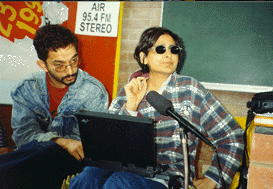
     

    17 Days before her death delivering a paper on women and Quraan


    Bismillah al-Rahman al-Rahim

    Alhamdulillah al-ladhi hadana li hadha wa ma kunna li nahtadiyya lawla an hadhanallah

    In the Name of God, Most Gracious, the Dispenser of Grace

    All praise is to Allah, Who has Guided us to this. Were it not for His Guidance we would surely have been lost.


    Introduction

    We will be discussing an important arena of the Struggle in upholding the dignity of Muslim women in Islam and the Muslim community. That is the Ideological struggle – the struggle to grasp the existing controversial and conflicting perception of the status, position, worth and constitution of women – a perception used to control women’s actions and status. For Muslims, this perception is supposed to be derived primarily from the Qur’an and Sunnah.

    We will look into verses in the Qur’an that deal with principles and practices or law to ascertain the Qur’anic concept of Women and Gender Identity. For Muslims the Qur’an is the basis. I was also going to look at Hadith, but unfortunately this already looks like it will take all the time available.

    A good book for you to look at on the Prophetic Community is Leila Ahmed’s Women, Gender and Islam.

    But now I’m going to look only at Qur’an. The reason I want to look at it is in order to grasp the existing controversy and conflicting perceptions on the status, position, worth and constitution of women, perceptions used to control women’s actions and status. The perception is that Islam has placed a low status on women and a higher one for men. We will look at the verses that deal with principles and practices or law to ascertain the Qur’anic concept of women’s gender identity.


    An intellectual Exercise?

    The question one could ask is: Is it just an intellectual exercise.

    Some activists regard an ideological investigation as an “intellectual exercise” undertaken by people not involved in the real issues.

    When I informed the ITP co-ordinator about the focus of this paper, this is how she responded in her email message to me:

    > Regarding the brief itself, I have only to indicate that when this
    > topic was suggested in the first place, I expressed that we have to
    > look at new ways of tackling the issue because we always cover the
    > same ground and get nowhere due to the stubbornness and even
    > arrogance sometimes on the part of ourselves to accept what is
    > actually a very black and white issue. That is why I suggested
    > initially that, instead of trying to “emancipate” a group of
    > middle-class, somewhat pampered women who really have no affinity to
    > the REAL issues facing the struggle for gender equality in this
    > country, we devote our precious time to looking at ways for bringing
    > the Gender Desk closer to reality, like the W.Cape has done. It is
    > fine by me if you want to look at Qur’anic perspectives and all
    > that, but I think that the idea that we are actually going to GET
    > somewhere, or make known some things that were not known before,
    > needs to be read with caution

    I think I agree with the co-ordinator, the liberal class does do that. But in Islam the Qur’an applies to all, whether it’s post-middle, pre-middle or working class. The same laws apply to the couple, the same laws apply to the man. And all classes need to know that because that forms the basis of their identity. So it’s slightly different, and also I thought it was important that we deal with that, because in my experience – and I’ve been working with women since I’ve been the Gender Desk Co-ordinator more focussed on gender issues. And in Johannesburg they’re working with women in divorce cases, women that have been beaten and a whole host of women. And the only advice that I could give them was one that the Qur’an says this about you, gives you a status. Because I find it very difficult to tell somebody something that they don’t believe in. I can’t tell them, “Yes, get divorced.” But I can tell them, “You have a right to get divorced. The choice is now yours.” I suggest that they go for some social welfare service. So I think there’s a need for both kinds of things: like the one Cape Town (MYM) has and the kind of thing… What Cape Town does is integrate both. The more people know these issues, the more people will integrate them or deal with one only before the problem arises. So that’s how it should go.

    We cannot altogether dismiss the need for support and other social welfare services, and as long as the problems exist, it is essential that we have social welfare and other institutions that can provide necessary relief for victims. And these problems will continue for as long as there is confusion regarding the correct and liberatory Qur’anic position on women. We must tackle the problem itself and for Muslim women, Islam and the Qur’an can be both a force of empowerment and undermining and disempowerment. It is the source Muslims accept unflinchingly.

    The conflict and, yes, sometimes confusion in our understanding of Islam and gender status arises from the complex way in which a society works.


    Forces within the Muslim community that cause conflict and confusion in understanding Women, Gender & Islam

    After 1400 years it appears that there is still confusion and conflict as to the status of women in Islam, and the role that gender plays in an individual’s worth in terms of status, position, potential and constitution.

    Despite the overwhelming and strong position of Muslims that Islam liberated women 1400 years ago, you still find there’s a problem. Some thought and practice within Muslim society does not reflect this conviction, giving rise to the accusation that Islam oppresses women, to which the Muslim community reacts emotionally with denial and animosity, without reflecting inwardly and addressing the existing problems.

    And I think the reason for this is the way the Muslim community works. What makes Islam work in a Muslim community is a mixture of Islam, the context, an interpretation of Islamic text – Qur’an and Hadith, culture, tradition, customs and the interests of those who are dominant in the community – those who hold the reigns of power.

    These elements are not necessarily negative. The objective is not to apply some “purist” understanding of Islam based exclusively on the Qur’an. In fact, the Qur’anic and Prophetic method is to consider the other elements in order to provide a viable and practical solution to an event or problem. The Qur’an consists of Divine responses to particular questions within a particular context. Therefore it is essential that Islam and the Qur’an are contextualised.

    However, these elements that work within the Muslim community often do so at cross-purposes with conflicting agendas and motives. As a result we have conflicting messages. If somebody wants to subjugate women they will come with a different interpretation, they will do a whole host of things. So you’ll find conflict: in interpretation, in understanding who women are. And people tend to interpret for their convenience. However, I don’t think these elements are necessarily negative. In order for Islam to work it needs to be contextualised and not taking all these elements into consideration means you have not listened to one category or class of people. In fact the Qur’an and the Prophet did exactly that. They took into consideration the customs; they took into consideration a whole host of things in order to understand the laws within the context. It thus is often difficult to distinguish between these various elements. It is therefore not surprising that we are confused on the issues of women, gender and Islam and articulate and send conflicting messages.


    Muslim Feminists

    We’re seeing a lot of Muslim feminists. Their books have been translated into English and even in small communities like in South Africa. (I’m sure all of us are being accused of being feminists.) Muslim feminists face criticism from other feminists for insisting on maintaining the link to Islam in the gender struggle. The Muslim feminist looks to the Qur’an and the Prophet as a force for liberation, but in this ideological struggle faces tremendous opposition and criticism for “reinterpreting”, “changing the Qur’an”, “following western feminists”, etc. from the clergy, the community as well as other women.

    These feminists insist that they are inspired by Islam and the women heroes of Islam who stood up for justice and human rights. And that Islam is a force of empowerment rather than of disempowerment.


    Let’s live as we Believe

    There is a hadith which states a profound truth about human life: “If you don’t live as you believe, then you begin to believe as you live.”

    In order to live as we believe, and to understand what the Islamic and Qur’anic identity of the Woman is, it is essential that we do an enquiry and investigation of the Islamic sources – the Qur’an (in particular) and the practice of the Prophet’s community. Because of the short time available, I will focus here only on the Qur’an.


    The Qur’an: Principles, Practices and Law

    The Qur’an is the first source of guidance, so we’ll start by looking at what the Qur’an says about the position and place of women and what role, if any, gender plays in status of the individual.

    Perhaps an important point to make before we begin discussing verses of the Qur’an, however, is that all such discussion is based on contextual interpretation. No person can honestly claim to understand any part of the Qur’an without any interpretation.

    During the Battle of Siffin, the followers of Mu’awiyah once called for a cessation of hostilities between Mu’awiyah’s and ‘Ali’s parties. They should, they said, accept the Qur’an as the arbitrator between them. Imam ‘Ali’s response is very instructive. He said:

    “When Mu’awiyah invited me to the Qur’an for a decision, I could not turn my face away from the Book of Allah. The Mighty and Glorious Allah declared that ‘If you dispute about anything, refer it to Allah and His Apostle’. (However,) this is the Qur’an, written in straight lines, between two boards (of binding); it does not speak with a tongue; it needs interpreters and interpreters are people.”

    In order to ascertain the status of men and women we will look at verses that lay down certain principles and verses that are reactions to particular contexts.


    The Principles:

    O Humankind! Be conscious of your Sustainer, who has created humanity out of one living entity, and out of it created its mate, and out of the two spread abroad a multitude of men and women. And remain conscious of God, in Whose name you demand [your rights] from one another, and [reverence] the wombs [that bore you]. Verily, God is ever watchful over you! (4:1)

    The points I’d like to highlight here…

    The source of all human creation is one living entity, unlike the biblical interpretation or understanding that men were created first and thereafter women, and women were created from men. Even upto recently, I had the idea that women were created second also, and that men were created first and that women were created out of men. And here it is quite clear that No, there was this one “entity” and Allah created men and women from it. So, women could have been created first or men could have been created first; it’s difficult to say. What we know is that from one entity multitudes of men and women were created. All individuals are born from one entity, according to this verse, and have the same status and equal potential to do good and evil.

    This is such a positive verse, and there are many like that. Why do we choose to make more popular the “negative” ones like the one that can be interpreted that men can beat women. Why not this verse and on the basis of this verse interpret that. If one comes to this first you know that gender doesn’t play a part in spirituality or anything.

    If you come with the idea that you are inferior in the first place, your approach to a particular verse that applies to a particular context will have to be negative, will have to see you as inferior. Whereas, if you have a positive one, it will have to be positive, it will have to accept that there is some kind of equality here. You’ll need to interpret a verse on how you treat somebody according to what the Qur’an says are basic principles or what basic essence of women or men is.

    Verily, for all men and women who have surrendered themselves unto God, and all believing men and believing women, and all truly devout men and truly devout women, and all men and women who are true to their word, and all men and women who are true to their word, and all men and women who are patient in adversity, and all men and women who humble themselves [before God], and all men and women who give in charity, and all self-denying men and self-denying women, and all men and women who are mindful of their chastity, and all men and women who remember God unceasingly, for [all of] them has God readied forgiveness of sins and a mighty reward. (33:35)

    This verse shows clearly that all spiritual and moral obligations of men and women are the same. And that the ones capacity is not inferior to the others.

    It stresses the moral rights and moral obligations of men and women. And if God has given men and women the same obligations it is only because they have the same potential. God is Merciful. He won’t apply greater responsibility than one can bear. Many a time what we have is people claiming that women are morally inferior or spiritually inferior. They menstruate, they are not capable, they cause fitnah. And the Qur’an clearly states that The Merciful God can never place obligations greater than one can bear. And if she’s not spiritually whole or morally whole then you can’t expect her to be equally moral and equally spiritual. And this verse says that we are equally so.

    Hence do not covet the bounties which Allah has bestowed more abundantly on some of you than on others. Men shall have a benefit from what they earn, and women shall have a benefit from what they earn. Ask, therefore, Allah (to give you) out of His Bounty: behold, Allah has indeed full knowledge of everything. (4:32)

    This verse is very clear. That we shall all be rewarded according to what we earn. And also that one will be rewarded for whatever good deeds one does.

    There’s also the verse that men and women that do good deeds will be rewarded according to their deeds and their work. Often times we hear the “hadith” that when the Prophet (s) went to Hell he saw more women in Hell than men. If women were more prone to evil, why would God give them equal obligations to do moral good.

    These are few of the “positive” verses which lay down the basic principle that gender is not a criterion for determining the status of the individual.

    I would be failing in completing the discussion if I left out the more popular verses used to describe women’s identity.

    Degree above:

    Often, to uphold the superiority of men, people say that the Qur’an says that men are a degree above women. And yes, that’s true. It does say it.

    Women who are divorced shall wait, keeping themselves apart, three (monthly) courses. And it is not lawful for them that they conceal that which Allah has created in their wombs if they believe in Allah and the last day. And their husbands would do better to take them back in that case if they desire a reconciliation. And (the rights) due to the woman are similar to (the rights) against them, (or responsibilities they owe) with regard to the good (ma’ruf), and men have a degree (darajah) above them. Allah is Mighty, Wise. (2:228)

    This verse refers to a context of a couple getting divorced and there is the possibility of a pregnancy. It calls on women not to conceal their pregnancy. And it is better for their husbands to take them back if reconciliation is possible. While women have similar rights to their responsibilities, men have a degree of rights and responsibility above them a degree above them.

    This verse is often used to quote the “degree above them”. It’s not applied to the context. I’ve even heard our (MYM) members trying to come to grips with men being a “degree above them”! That’s just accepted. The problem is that it applies to a particular context, not to general law meaning that men are a degree above women. This verse speaks about pregnancy when divorce is taking place. If the wife is pregnant she has no right to conceal the pregnancy. Which is fine. It should be so. Also the fact that the men do have a degree of advantage in taking the child back. The verse speaks about the rights that women have and the rights above them and then speaks about men having a degree above them. So the degree is with respect to responsibilities (rights against them) as well as rights. We must also remember all the time that what they have has been bestowed by Allah. It’s not from themselves; it’s from Allah. And they have a responsibility to give.
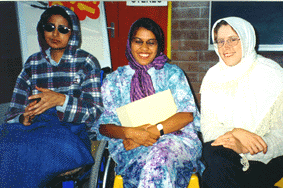
    Shamima with co-presenters of the session: Firdousa Waggie and A'isha Roberts

    Maintenance, Beating and Marriage:

    Men are qawwamun (maintainers/protectors) of women, for Allah has preferred (faddala) some over others, and (on the basis) of what they spend of their property. So good women are qanitat (obedient), guarding in secret that which Allah has guarded. As from those whom you fear nushuz (rebellion), admonish them, banish them to beds apart, and scourge/beat them. Then, if they obey you, seek not a way against them.(4:34)

    Men are maintainers of women because Allah has bestowed more on some then others. That’s why they are supposed to be maintainers. The fact is they generally have more money than women. Also, the situation of divorce. If you’re pregnant it’s more of a burden sometimes and you need assistance.

    Then the verse says Allah has bestowed more on some than on others because they have an extra responsibility.

    So good women are “qanitat“. Generally it seems from the Qur’an that the one that contributes more, takes on more responsibility has more rights. The less responsibilities they have, the less rights they have.

    Then, if you fear rebellion from them, there are three stages of correcting: admonish them, banish them to beds apart, and then beat them lightly. The one that causes most grief in the community is that men are allowed to “beat” women or one individual is allowed to beat another, especially in a marriage. This notion has always bothered me. But if I look at the stages through which one goes, through the process. First it’s “admonish them”. (If it says “beat them lightly” then admonishing would be, for example, just saying “stop it” or something like that. Not yelling or shouting, but something light.) And then “banish them to beds apart”. I don’t believe anybody, any rapist or abuser – according to the profiles for such people – will get to the second stage. Rapists and abusers (that are spouses), generally they’d sleep with her first. Generally they sleep with the victim then beat them then sleep with them again. A normal, good Muslim will never reach that stage, the stage of banishing them. An abusive husband will do things the other way around.

    The word “nushuz” is quite a strong word. It means rebellion. And only a “rebellion” allows a man to go through these stages. People are defiant and disobedient everyday; but this “nushuz” is quite strong. The issue with this verse is how we deal with it and how we are prepared to deal with it.

    Marriage relationship:

    And among His wonders is this: He creates for you mates out of your own kind, so that you might incline towards them, and He engenders Love and Tenderness between you: in this, behold, there are messages indeed for people who think. (30:21)

    Here is portrayed a relationship that is tender and a relationship that’s based on tenderness and love. Here’s another principle that one can draw on for a marital relationship.

    It is lawful for you to go in unto your wives during the night preceding the (day’s) fast: they are as a garment for you, and you are as a garment for them.

    Seclusion & separation (Prophet’s wives):

    O Prophet! say to your consorts: “If it be that desire The life of this world, and its glitter, then come! I will provide for you enjoyment and set you free in a handsome manner.

    But if you seek Allah And his Apostle, and the home of the hereafter, verily Allah has prepared for the well doers amongst you a great reward.

    O Consorts of the Prophet ! If any of you were guilty of evident unseemly conduct, the punishment would be double to her, and that is easy for Allah.

    But any of you that is devoted in the service of Allah and His apostle, And works righteousness, to her shall We grant her reward twice and We have prepared for her a generous sustenance.

    O consorts of the Prophet! You are not like any of the (other) women. If you are conscious of Allah, be not too complacent of speech, lest one in whose heart is a disease should be moved with desire. But speak you a speech that is just.

    And stay quietly in your houses, and make not a dazzling display, like that of the former times of ignorance; and establish regular prayer and give regular charity; and obey Allah and His Apostle. And Allah only wishes to remove all abomination from you, you members of the family, and to make you pure and spotless. (33:28-33).

    These verses – the seclusion, the voice story, the staying at home, etc – what one needs to make quite clear is that these verses refer to the Prophet’s wives. Firstly, they will get twice the reward than any other woman will get. But also, there are greater responsibilities and restrictions for what they do. So they’ll get double for doing it, as well double sin.

    The verse: “O consorts of the Prophet! You are not like any of the (other) women. If you are conscious of Allah, be not too complacent of speech, lest one in whose heart is a disease should be moved with desire. But speak you a speech that is just.” is the verse the Jamiat uses to support their no-woman’s voice position. What is clear here is that firstly it’s speaking to the Prophet’s wives only (which they didn’t mention), and secondly – not that they shouldn’t speak but that they should not speak in complacent but in just terms, that their speech is just. What the Jamiat also didn’t do is say the last bit: “But speak you a speech that is just.” All they quote is: “If you are conscious of Allah, be not too complacent of speech, lest one in whose heart is a disease should be moved with desire.” That sentence is part of the verse, but the Jamiat chooses not to quote it. For their convenience, they use the verse to support their position. This is devious! We often do that.

    “And stay quietly in your houses.” Here again is the Tabligh Jamaat position that women should be confined to their homes. People could do that if they like, but the Qur’an is instructing the Prophet’s wives in this instance and not saying it is a general rule.


    Challenges

    I want to look finally at the challenges that we face and that we need to deal with. The issues here we need to deal with practically.

    We should now stop focussing on verses that are interpreted to imply a lower status of women. We of often ignore the principles. We need to extract these to apply to new practical contexts.

    We should also make sure and challenge people who interpret and use verses of selective & convenient text like the Jamiat’s use of verses to argue that women’s voices can’t be heard. There’s the of pamphlet supporting women’s voice not being heard, where the supporters give weight to their position by quoting only part of the verse only .

    Another problem is that “religious authorities” cannot deal with these issues and challenges. They are not qualified to do so; there’s a lack of education, experience and commitment to the reopening of the doors of ijtihad. They are not thinking or reflecting but remain static. And we should ask these “authorities” to also engage in ijtihad. They are also afraid of reform and of challenges to their authority. We must keep challenging them.

    Also they don’t respond very well to challenges. Everytime we challenge them, everytime we speak to them, they don’t respond. Around two years ago, when I was the Gender Desk Co-ordinator, I wrote to the Jamiat about the husband’s right to unilateral divorce. They argued that it is Qur’anic, it is Islamic. Then I quoted them a whole lot of verses and told them that these verses showed that marital relationships don’t adhere to the kind of talaq with a complete lack of consultation. I sent them a five-page letter quoting these verses. They sent me a reply asking Allah to give me hidayah (guidance) and saying that I was very arrogant. This United Ulama Council, this big organisation with hundreds of maulanas, tells me that I’m arrogant and may Allah give me hidayah and this was their last correspondence with us. I felt sick!

    Another problem is that men write women into their experiences, For a long time men have been writing about women, men have been writing the interpretations. Even if a progressive man writes about women, it’s from a male perspective. They write us into their experiences. Ebrahim Moosa (a leading South African and international progressive Muslim theologian and scholar) experiences life much differently than I do. He’s progressive, fine! But I’d rather Firdousa (the MYM Gender Desk co-ordinator) wrote it. It would be more real. Our experiences are different because we’re in an oppressive situation.

    Even some of the women writers that are emerging are the more conservative ones who write from tradition. They don’t change things, they just focus on what’s there.

    That leads us to the next point. That women generally retain and accept traditional stereotypes. Women are more passionate about retaining tradition than men. We find women often just want to keep the peace. It’s in their family lives and comes out in their wider lives. But they could change, and that’s what we should attempt.

    The last issue I want to raise is that Muslim Personal Law is being developed as we speak. We need to find out what is happening, otherwise we will wake up with a rude shock when things are already done. We need much reform in this field and a fresh interpretation of MPL.


  • Hajj and Freedom – not for women, it seems

    Women are often the sacrificial lambs when Muslims have to deal with “problems” in our community. Men are unable to control their libidos so women are punished – confined to the homes, relegated to galleries (in mosques) and their voices suppressed. That women fall victim to chauvinistic laws is not surprising, considering that the community, men and women, are often fed with selective information.

    Regulations around gender and haj starkly illustrate one type of chauvinism. Not too long ago the Saudi Government introduced a law that forbade women under the age of 45 from undertaking the haj without a mahram (either a husband or a man she cannot marry, like a close relative). This meant that women under 45 could go for haj only if there was a mahram willing to “take her” for haj.

    Previously, women were allowed for haj in groups without a mahram. Among most schools of thought it is accepted that a woman may travel with a group of trustworthy women or even with a trusted woman companion. There is also a view that a woman may travel by herself, provided the way to haj or ‘umrah is safe. The Prophet (s) is reported to have replied to a man who complained about highway robbery, “If you lived long enough you will see that a woman will travel from Hira (in Iraq) and will perform tawaf around Ka’bah, and she will have no fear except that of Allah.”

    The Qur’an speaks of the peace, security and freedom from fear at Makkah. “Behold, the First Temple ever set up for humankind was indeed the one at Bakkah (Makkah): rich in blessing, and a (source of) guidance unto all the worlds. (It is) the place whereupon Abraham once stood; and whoever enters it finds inner peace and freedom from fear. Hence Pilgrimage unto the Temple is a duty owed to Allah by all people who are able to undertake it. And as for those who deny the truth, verily Allah does not stand in need of anything in all the worlds” (Qur’an 3:96-97).

    We need to recall only the story of Hajar (s), to have a proper perspective of the issue. She stayed in the desert with her infant son Isma’il because of her faith in God, and her fear for God alone. She did not have a mahram, she survived with the infant by striving to take care of herself and her son with the help of God. Ibn ‘Abbas relates the incident thus: “Prophet Ibrahim (s) brought Hajar (s), his wife, and their son Isma’il (s), whom she was still nursing, and left them at the House of Allah under a tree above the Zamzam. Makkah at that time was a place where there was neither water nor any dweller. He left a bag of dates and a container of water for them. Then Ibrahim (s) turned to go away. Isma’il’s mother said to him, ‘O Ibrahim! Where are you going? And who are you leaving us to in this valley without a companion or a thing?’ She repeated this several times but he did not respond. At last she asked him, ‘Has Allah commanded you to do so?’ He answered, ‘Yes.’ Thereupon she said, ‘Then He will not let us perish!’ (Bukhari).

    One cannot help but be inspired by this black slave woman who actively strove to please Allah and survive in the harsh desert. One must remember that a central person whom Muslims follow during the haj is Imama Hajar, a woman.

    Women had been performing haj and ‘umrah, travelling in groups, enjoying the haram’s security and access to the Houses of Allah – which is denied to them in some parts of the world. This freedom was then snatched away from an already suppressed group within the community. If the Saudis wanted to control the numbers entering Arabia they could surely have used other methods. But it is easier and one is less likely to face resistance if one deprives a sector that already does not have a voice.

    The mahram law effectively bars some Muslims from fulfilling a religious obligation (fard). There are many reverts particularly, on whom haj has become obligatory but who don’t have Muslim mahrams. This is especially true in a Muslim minority country like South Africa. The recently-formed South African Haj and ‘Umrah Council, whose task it is top ease the way for South African hujjaj, should challenge this regulation and request an exemption to this kind of discrimination.

    Once a Muslim has the means to perform haj it becomes obligatory on him or her. One never knows what the future holds; deferring the haj could mean that one would lose the opportunity and means to perform it. Ibn ‘Abbas related that the Prophet (s) said: “He who intends to perform haj let him do so expeditiously, for he may well fall sick, may lose his mount (ability to bear expenses of the journey) or may be prevented by some other exigency.”

    The strange exemption for women over 45 indicates the mind set behind the law. It seems to be more about sex than safety.

    Besides the mahram law, many other (official and unofficial) regulations on haj are riddled with many prohibitions for women which cannot be attributed to the Prophet (s): they must not make ramal (brisk walk) while making tawaf; they must not jog the short distance between Safa and Marwa – the Milain Akhdarain – (even though the act is to commemorate a woman Hajar, who ran from Safa to Marwa); they must not make their way to the Hajarul Aswad or pray near the Maqam Ibrahim; and books distributed in South Africa claim they must perform all their salah in their apartments/hotels and not in the Haram; they must perform the tawaf on the outskirts and not try to get close to the Ka’bah; in a crowd of hundreds of thouands they must keep a clear distance from men; they must not say the talbiyyah aloud…

    Yes, the Prophet and Allah stress that there is no need to overburden oneself. But only the individual knows the burden that he or she can carry, and each person should have the right to choose the most convenient. Gender cannot be the criterion for deciding one’s ability for these rituals.

    * Shamima Shaikh wrote this article under the pseudonym Salma Said. It was published in Al-Qalam.