By Na’eem Jeenah and Shamima Shaikh
Published by Full Moon Press (2000), Cape Town, South Africa
ISBN 0-620-26405-5
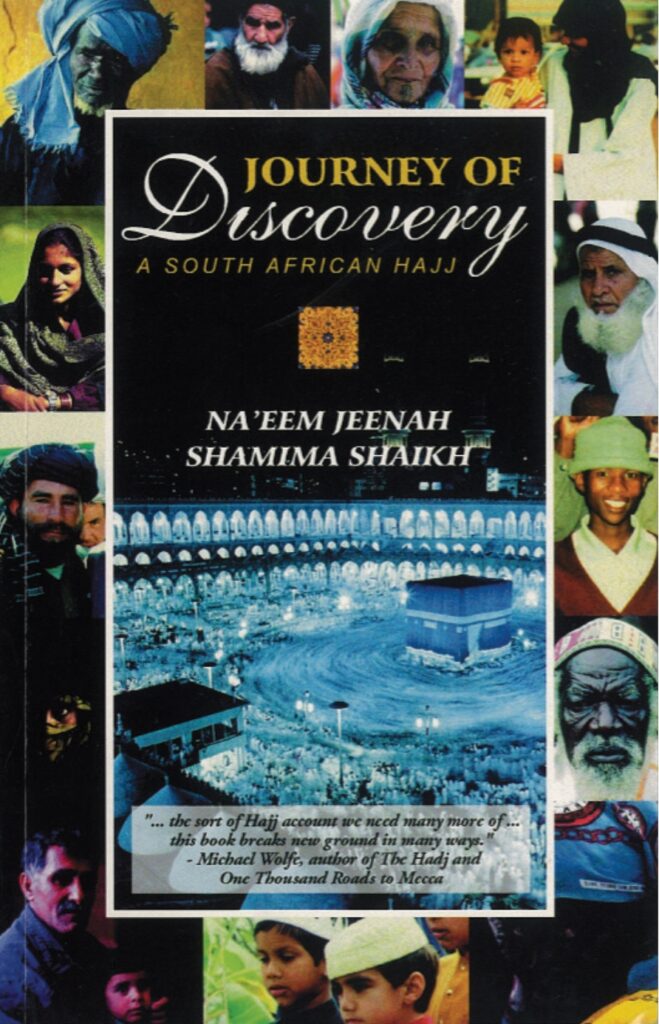
Some comments about the book:
Michael Wolfe
Author of: The Hadj: An American’s Pilgrimage to Mecca and
One Thousand Roads to Mecca: An Anthology of Pilgrim Travel Writing
This is the sort of Hajj account we need many more of: an honest assessment of an experience shared by millions world-wide, which does not leave out the personal, but rather successfully reminds us that every pilgrim comes from somewhere, from a specific place, a particular family, a politics and a social point of view informed by Islam: in this case, South Africa. And how few books of any kind are written by a husband and wife who enjoy, respect and understand each other! This book breaks new ground in many ways. May other pilgrims follow its fine lead.
Shamil Jeppie
University of Cape Town
I very much liked the whole thing. It is well written, clear, and captivating. The hajj came alive for me like no other description I’ve read before… I still wanted more when I closed the manuscript. Indeed, after each chapter I felt I wanted it to continue. I’m certain many other readers will respond in the same fashion… I thoroughly enjoyed it.
Tamara Sonn
College of William and Mary
This is a unique book, actually groundbreaking in the field of Islamic studies. It is, on its surface, a personal story of a South African couple making their first pilgrimage to Makkah (Hajj) together. The authors are highly intelligent, well educated, slightly sarcastic, but very devout in a way that resonates with the faith of other young people throughout the world. But this book is more than the musings of young professionals on the meaning of a traditional ritual. The authors are South African activists struggling against apartheid and its aftermath. At the same time, Shamima and Na’eem grapple with gender and authority issues within Islam, especially as these issues question their social activism. Their book is therefore a focused story of Muslims committed to social reform and seeking to reconcile their activism with their deeply traditional faith. The story is made all the more poignant knowing that the trip is both the vehicle of spiritual discovery and the couple’s last trip together. Shamima died a few months later, leaving Na’eem to bring up their two young sons and make sense of their journey(s) together. There have been several books published recently on the Islamic pilgrimage: F.E. Peters, The Hajj: The Muslims’ Pilgrimage to Mecca and the Holy Places (Princeton, 1994); I.R. Netton, Seek Knowledge: Thought and Travel in the House of Islam (Curzon, 1966); and most recently, Michael Wolfe, ed., One Thousand Roads to Mecca (Grove, 1997). None of these, however, has the accessibility and personal appeal that Na’eem and Shamima have achieved in their Journey of Discovery. More importantly, none has incorporated the meaning of the pilgrimage into the spiritual and social landscape of Muslim life in the contemporary world, as theirs has. This book is easy to read, yet highly charged intellectually and emotionally, making it a good choice for undergraduate classroom discussion. It is also attractive to a non-specialist readership.
Laila Al-Marayati
Chairperson, Muslim Women’s League, USA
The style is open and inviting and made me feel as if I had accompanied [the] group on its journey. [The] discussion of the significance of the rituals from a spiritual and meaningful Islamic point of view was very enriching. I felt I was seeing things that I already knew in a different and more compelling light. The humor was apparent throughout and is something that is sadly lacking in other books as it seems that we Muslims are unable to laugh at ourselves in general. Several (South African) references were extremely relevant and eye-opening for those of us who were not present during the resistance to apartheid.
from the ‘Foreword’ by Amina Wadud
Virginia Commonwealth University
In sharing their Hajj experience Shamima and Na’eem allow us to witness how Islam as engaged surrender is put into action. For one thing, we are reminded that the struggle goes on at multiple levels. At times we are witnesses to their joy and at other times to their frustrations. We witness small victories and defeats. The Hajj for Na’eem and Shamima is full of the ups and downs of the life journey. In this context Islam as engaged surrender reminds us that we must make our path as we walk it.
from the biographical chapter by Abdulkader Tayob
University of Cape Town
[Shamima] and Na’eem seemed to have discovered different levels of their relationship with God, community and nation. This profundity certainly oozes through the pages of this text as the Hajj brings together their spirituality and their social conscience.
Read the following reviews of Journey of Discovery:
- Review by Zulekha Adam-Dinath – al-Qalam, November 2000
- Faith on the move, Review by Khadija Magardie, Mail & Guardian, 12 January 2001
- A Fine Example of “Living Islam”, Review by Aslam Fataar & Najwa Nordien, al-Qalam, December 2000