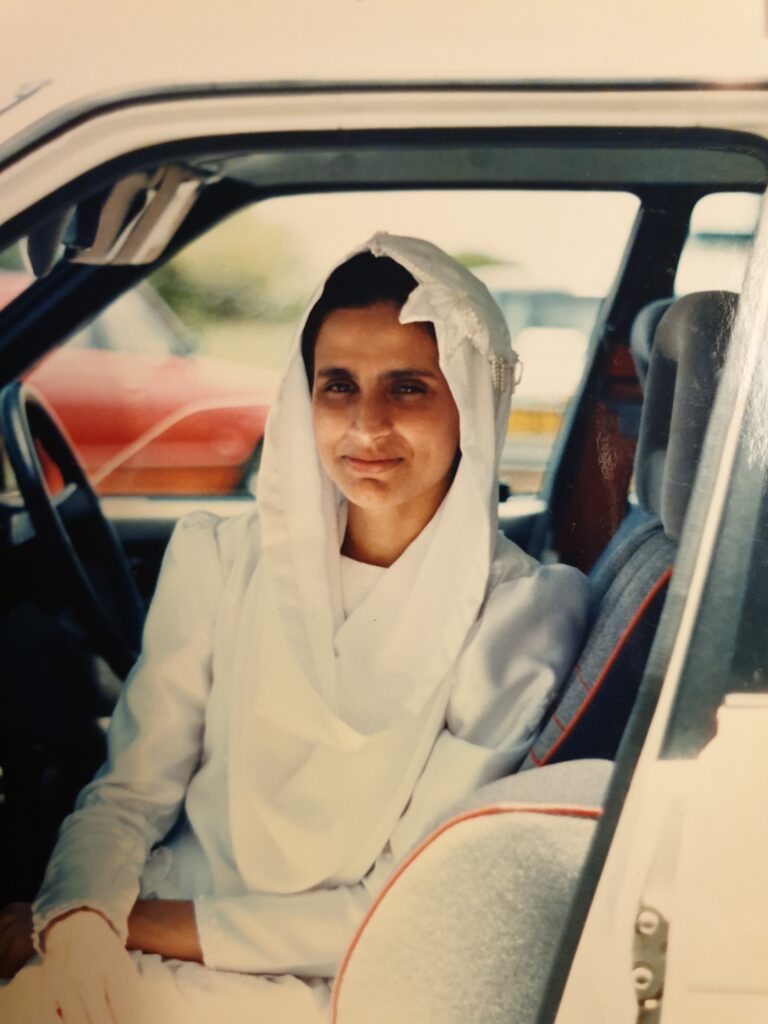
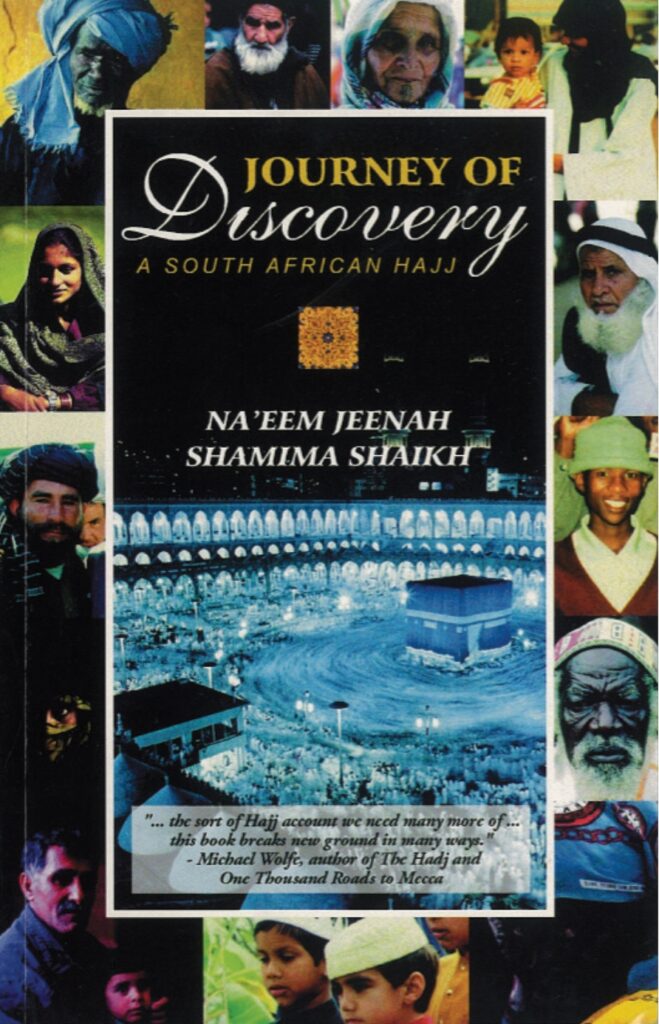
Presented to the Jamaat Khana Committee of the University of the Witwatersrand – 1995. Shamima was a ‘community member’ of the committee which was negotiating with the university administration for a new Mosque complex and participating in decisions regarding the design of the complex. She argued for women to be accommodated in the ‘main space’ of the mosque.
An ‘Ignorance’ that’s frightening
I was prompted to put together these few thoughts after a meeting with a group of architects (who are also popular mosque designers in South Africa) and students who presented their proposals for the WITS mosque. The architects expressed their certainty as to where a woman may be located in a mosque, saying that any other accommodation was bid’ah (innovation). A young student presenting his design said women and men reading alongside was unacceptable; they had to be completely separated (he said that women should be accommodated in a gallery). His other assumption was that men at WITS could not control their libidos.
It was their certainty that their beliefs and perspectives were actually the Prophetic tradition and that anything else was bid’ah, that I found frightening. I was in no doubt about the sincerity and love these men have for the Prophet (pbuh). It is because of this and my own love for Islam and the Prophet (pbuh) that I feel the need to inform them about what I’ve come to learn about women and the space they occupied in the Prophet’s mosque.
Women’s Space in the Prophet’s Mosque
Women occupied the back rows of the Prophet’s mosque; where they could be seen and heard by the rest of the congregation. (Remember that the Prophet’s mosque was fairly small.)
Ibn Abaas (ra) said: “Once the Prophet came out (for the ‘Id prayers) as if I were just observing him waving to the people to sit down. He then, accompanied by Bilal, came crossing the rows till he reached the women. He recited verse 12 of chapter 60 to them and asked: ‘O ladies, are you fulfilling your covenant?’ None except one woman said ‘Yes’. The Prophet then said: ‘Then give sadaqah.’ Bilal (ra) then spread his garment and said ‘Keep on giving alms’. 1
Access to the Imam
Direct contact between the Prophet, as the imam who led the prayers, and those who attended the prayers seems to have been an important element in the Friday khutba:
“. . . On Friday he (the Prophet) preached the khutba leaning on a staff. . .. And the people were in front of him, their faces raised toward him, they listened as they watched him. . . .”²
The idea that the mosque is a privileged place, the collective space where the leader debates with all the members of the community before making decisions, is the key idea of Islam which today is presented to us as the bastion of despotism. Everything passed through the mosque which became the school for teaching new converts how to do the ritual prayer, the principles of lslam, how to behave towards others in places of worship and elsewhere. Was it fitting to come armed or not? Could one do buying and selling there (the Prophet and his Makkan supporters were originally merchants)? Could one keep prisoners of war in the mosque courtyard (to keep better watch on them) or not?³
The mosque was a space where dialogue between the leader and the people could take place. The apparently simple decision to install a mimbar in the mosque was treated by the Prophet as a matter that concerned all Muslims:
The Prophet used to say the Friday prayers standing, leaning against a palm trunk. One day he announced that standing made him tired. Tamim al-Dari answered: ‘Why not build a pulpit like I have seen in Syria?’ The Prophet asked their advice on the question, and they agreed to the suggestion.(4)
A Madinah carpenter cut a tree and built a pulpit with a seat and two steps up to it.
Other versions say that the Prophet was urged to take his place on the mimbar at the time of prayer so that he could be seen by everybody, because in a few months the number of Muslims had grown considerably, and this seemed a more plausible reason than fatigue. The Prophet was only 54 years old at the time of the Hijra and was in the prime of life.
From access to denial of access
In the Kitab al-Jum’a (Book of Friday) of Imam Bhukhari (d. 256H),(5) who wrote two centuries after the death of the Prophet (pbuh), he quotes the hadith:
“Do not forbid the mosques of Allah to the women of Allah.”
A half-century later (300H), Imam Nasa’i, wrote his al-Sunan. In his chapter on al-masjid, he gives specifications for the rows between men and women: how crowded they may be and how far from each other.
He states that a man has no right to forbid his wife to go to the mosque. He quotes the Prophet:
“When a woman asks authorisation from one of you to go to the mosque, let him grant it to her.”(6)
Ibn al-Jawzi (d. 597H), wrote a book on the laws that govern women in Islam and devoted his chapter 24 to ‘Women’s Friday Service’. He had to acknowledge that they had a right to the service since the hadith on the subject was incontrovertible. However he raises four issues:
On the question of rows he said ‘the prayers of men who are seated behind women are worthless.’(7) It often happened that men came to the mosque late and were blocked by the rows of women. It is very easy to imagine the fatal next step: ban women from the mosque, since the mere presence of women risked creating a problem.
Ibn al-Jawzi than asks a question which in itself contains a betrayal of the ancient texts: ‘Is it permitted for women to go to the mosque?’ And his answer: ‘If she fears disturbing men’s minds, it is better for her to pray at home.’(8)
He cites Bukhari’s key hadith in which the Prophet stresses that the mosques of Allah are not forbidden to women. He concludes by saying that ‘the Friday service is not a duty for women’.(9) And, ‘A woman should try to avoid going out as much as she can.’(10)
But it is in reading modern authors like Muhammad Sadiq al-Qannuji, the twentieth-century Indian scholar (d. 1308H), that one notes the institutionalisation of the exclusion of women from such a crucial place as a mosque. In his chapter on “What has been said on the fact that the Friday sermon is not a duty for women”, he brings out a dubious hadith which says: “The Friday service is a duty for all Muslims, with four exceptions: slaves, women, children, and the ill.”(11)
We are certainly a long way from the Prophet’s mosque, open to all, welcoming all those interested in Islam, including women. The mosque now suffers a betrayal of Muhammad’s (pbuh) ideal community: women are declared strangers to the place of worship. Women, who had the privilege of access to the mosque as sahabiyyaat, companions of the Prophet, very quickly became polluting, evil beings.
Sexual men and invisible women
The premise that women ‘distract’ men from their spiritual endeavours and that they stimulate sexual urges rests on a certain understanding of what it means to be human, and a certain understanding of what constitutes maleness and femaleness.
This argument operates from the premise that our focus of control, and our focus of self as human beings, as Muslims, is outside ourselves, and that men have weak inner centres since, upon seeing and listening to women, they are overcome by irresistible uncontrollable sexual urges. By such reasoning we imply that man are incapable of taking moral responsibility for their behaviour and relations.
The solution is to manipulate the external environment – women must be invisible – to keep men’s responses in check. This raises important questions: What does this say about man’s capacity to take full responsibility for his spirituality? On what understanding of humanity are these arguments based?
In order that we believing men and believing women, God-conscious men and God-conscious women, can reclaim our full humanity, reclaim our Islam, we need to revolutionise our categories of maleness and femaleness. We must reject the idea of uncontrollable male sexuality and evil women.
Allah says in the Qur’an: “The Believers, men and women, are protectors one of another: they enjoin what is just, and forbid what is evil: they observe regular prayers, practice regular charity, and obey Allah and His apostle. On them will Allah pour His mercy: for Allah is Exalted in Power, Wise.”(12)
Therapy for male ‘sexuality’
For those men and women who view each other only as sexual beings, the mosque precinct – a holy precinct – can be therapeutic. On seeing women in the holy precinct, the depraved soul has to recognise that women are not just sexy beings but spiritual beings, members of the ummah, their sisters in faith. If women are invisible in this holy precinct his perception of women as just sexy beings will not be challenged and he will never be able to reclaim his full humanity, his Islam.
May Allah guide us and help us respect each other
___________________________
(1) Bukhari, vol. 2, no. 95
(2) Ibn Sa’d, Tabaqat, vol, l, p, 238
(3) One of the most fascinating descriptions of the Prophet’s mosque is in Imam al-Nasa’i, Sunan, vol. l, pp. 31- 59
(4) Ibn Sa’d, Tabaqat, vol. l, p. 250
(5) Askalani, Fath al-bari, vol. 3, p. 34
(6) Imam Nasa’i, Sunan, vol. 2, p. 32
(7) Ibn al-Jawzi, Kitab ahkam al.nisa’ eirut: Al-Makbba al-’Asriyya, 1980), p. 201.
(8) Ibid., p. 202.
(9) Ibid., p. 205.
(10) Ibid., p.209.
(11) Muhammad Sidiq Hasan Khan al-Qannuji, Husn al-uswa bima tabata minha allahi fi al -niswa (Beirut: Mu’assasa al.Risala, 1981) p. 345.
(12) Qur’an (9:71)
Sources:
Fatima Mernissi, The Forgotten Queens of Islam.
Sa’diyyah Shaikh, Sexual men and Spiritual women