Author: shamsadmin

  • Famous Feminists: Ms Shamima Shaikh

    By Tina Price-Johnson

    Shamima Shaikh was born on 14th September 1960, the second of six children of Salahuddin and Mariam Shaikh. Her family moved from Louis Trichardt (in the Limpopo Province), South Africa to Pietersburg (now called Polokwane), where she graduated from high school. Ms Shaikh then attended the University of Durban-Westville, at that time an institution listed by the apartheid government as reserved for students of Indian ethnicity.


    Whilst studying Arabic and Psychology at University Ms Shaikh became involved with the Azanian People’s Organisation (AZAPO), a political group which was inspired by the Black Consciousness Movement (BCM) which was founded in the 1960s to fight apartheid in South Africa.

    In 1985 Ms Shaikh was elected to the executive committee of her university’s Islamic Society. The society supported a call for a general boycott by the Federation of South African Trade Unions through the Muslim Students Association of South Africa group. On 4th September Ms Shaikh was arrested for distributing pamphlets encouraging a boycott of Durban white-owned businesses. Ms Shaikh was held in a cell with the President of the MSA, Na’een Jeenah, and from this time they development a personal relationship. Neither were charged, and in 1987 they married and eventually had two children.

    After her graduation in 1985 Ms Shaikh followed a career in education, taking a position as Teacher at Taxila Primary and Secondary School Pietersburg. In 1989 Ms Shaikh joined the Muslim Youth Movement and her activism increased; attending and speaking at numerous rallies and events against apartheid, notably the specific campaigns against the Tricameral Parliament elections for the “Indian” and “Coloured” race groups and the defiance campaign of the Mass Democratic Movement.

    In 1993 she was elected MYM Chairperson for the Transvaal region, only the second woman to hold the position. In that year she began the campaign that was to make her famous; “Women in the Mosque”. Ms Shaikh and some other women within MYM encouraged women to attend the tarawih prayers at the 23rd Street Mosque in Fietas in Johannesburg. This led to clashes between her and in particular the male members of the mosque committee and gained much media coverage, the majority negative.

    In the same year she became National Coordinator of the MYM Gender Desk, a position she held until 1996. Ms Shaikh organised various workshops, seminars and campaigns through her position with the MYM. She spearheaded the MYM’s “Campaign for a Just Muslim Personal Law”, the “Equal Access to Mosques” campaign and various others. The organisation rapidly became the leading organisation in Islamic Feminism in South Africa. Although apartheid officially ended in 1990, it was not until 1994 elections were held. Ms Shaikh was active in campaigns to encourage voters to opt for parties which had always fought apartheid through the Muslim Forum on Elections.

    By 1994 Ms Shaikh had helped found and become the first Chairperson of the Muslim Community Broadcasting Trust, a position she held until her death. She also helped establish the Muslim Personal Law Board of South Africa, which sought to apply Islamic law alongside South African law for Islamic people. The Board proved fraught, with divisions arising within it and clashes with South African law, and it was eventually closed down by the United Ulama Council of South Africa.
    An eventful year, 1994 was the year Ms Shaikh was first diagnosed with breast cancer. After 12 months of gruelling and invasive treatments she entered remission, but vowed not to be treated again if cancer came back, stating she preferred to live a life of quality and die with dignity at home. Whilst battling cancer Ms Shaikh became Managing Editor of Al-Qalam, which developed into a beacon of modern Islamic expression throughout South Africa.

    In 1996 Ms Shaikh’s cancer came back. In 1997 Ms Shaikh completed a hajj (pilgrimage to Mecca) with her husband, as part of her journey through living with cancer. The experience led to a book, Journey of Discovery: A South African Hajj, published in 2000.

    In August of 1997 Ms Shaikh was head of the newly-launched Muslim community radio station, The Voice. Ms Shaikh delivered a paper entitled “Women & Islam – The Gender Struggle in South Africa: The Ideological Struggle” at the 21st Islamic Tarbiyyah Programme of the Muslim Youth Movement, at the As Salaam Educational Institute, on 22nd December 1997. This was to be her final public engagement and on 8th January 1998, the 9 Ramadan 1418, Ms Shaikh passed away.

    In her husband’s words: “Shamima’s mission in life was to struggle for justice; whether against white racists propping up apartheid or Muslim misogynists who wanted to ‘keep women in their place’.”


    Sources:

    By her husband, filed under Al-Qalam: http://alqalam.co.za/remembering-shamima-shaikh/

    http://persephonemagazine.com/2011/07/badass-ladies-of-history-shamima-shaikh/

    http://remembered.co.za/shamima-shaikh-7011

    http://en.wikipedia.org/wiki/Shamima_Shaikh

    http://www.aquila-style.com/focus-points/mightymuslimah/mad-courage-shamima-shaikh/82764/

    http://www.patheos.com/blogs/mmw/2009/06/remembering-shamima-shaikh/

    Adapted from the author’s post at: https://www.facebook.com/notes/this-is-what-a-feminist-looks-like/fotw-11-feb-2013-shamima-shaikh/538682936171964


    * See the author’s blog at http://fromthemindoftinapj.wordpress.com/

  • Shamima Shaikh: Why she kicks ass

    • She was South Africa’s best known Muslim women’s rights activist, a notable Islamic feminist and journalist.
    • In 1985, she was arrested for distributing pamphlets that called for a consumer boycott of white-owned businesses in Durban. The boycott had been called by the Federation of South African Trade Unions (Fosatu), the largest trade union federation in the country and supported by the Muslim Students Association of South Africa (MSA), which had organised the pamphlets. She spent the next few hours locked up at Durban’s CR Swart Police Station (now Durban Central Police Station).
    • She was later involved with a Muslim community newspaper, Al-Qalam which was being edited by her husband, and with the Muslim Youth Movement of South Africa (MYM). She was appointed Managing Editor of Al-Qalam, while battling cancer. Under her editorship, it became the flagship of a progressive expression of Islam in South Africa.
    • She became the first National Co-ordinator of the Muslim Youth Movement Gender Desk, a position that again put her on the MYM’s National Executive. Under her leadership, the MYM Gender Desk rapidly became the most outspoken Muslim organisation on the question of Muslim women’s rights and gender within the Muslim community and the leading organisation in the South African articulation of Islamic feminism.
      She also organised various workshops, seminars and campaigns. She spearheaded the MYM’s “Campaign for a Just Muslim Personal Law”, the “Equal Access to Mosques” campaign and various others.
    • She rallied around the Muslim Forum on Elections; a coalition of Muslim organisations that was calling on the community to vote in South Africa’s first democratic elections in April 1994, and to vote for those parties “that had formerly been part of the liberation movement” – in particular, the African National Congress (ANC) and the Pan Africanist Congress (PAC).
    • She helped found, and became the first chairperson of the Muslim Community Broadcasting Trust which applied for and was awarded a community radio licence for Johannesburg. She remained chair of the MCBT till her death.
    • She was also involved, from 1994, with the founding and establishment of the Muslim Personal Law Board of South Africa and was a member of the Board until it was unilaterally shut down by the United Ulama Council of South Africa.
    * Publishedhere, on the website “Women Who Kick Ass: We are all Wonderwomen!“

  • The (South) African Queen: Remembering Shamima Shaikh

    The (South) African Queen: Remembering Shamima Shaikh

    By Safiyyah Surtee, 4 June 2009

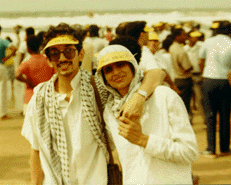
    Shamima and Na'eem at a "beach defiance" protest, 1989

    Muslimahs who work hard in shaping the depiction of themselves and their sisters in the media, and who are engaged in Islamic feminist discourse to dispel cultural and literalist concepts unjustly attributed to them, are often left flattened under the heavy heap of misrepresentations and stereotypes by both Muslim and non-Muslim agencies.

    I would like to dedicate my post for the week to one such South African woman, who fought against all types of oppression, especially against the oppression of Apartheid, Zionism and misogyny.

    Shamima Shaikh (1960-1998) was a journalist, media activist and Islamic feminist. Both her life and her death were symbols of struggle for the rights of Muslim women. I found it very difficult to articulate the magnanimity of Shamima’s life, so I turned to her husband, Na’eem Jeenah, for insight:

    Shamima’s mission in life was to struggle for justice; whether against white racists propping up apartheid or Muslim misogynists who wanted to ‘keep women in their place’.

    Deeply committed to the message of the Qur’an concerning justice and fighting oppression, she lived her life fighting for the right of all people to be treated equally as human beings, and for women, in particular, to be accorded their rights. She was inspired in all of this by the words of Allah. She was also one of the most compassionate people I know – towards everyone.

    She tirelessly worked for this message of this justice, including speaking, and writing. Shamima wrote for student publications, newspapers, and became the editor of al-Qalam, a South African Muslim community newspaper, and was the founder chairperson of the Muslim Community Broadcasting Trust, which owned The Voice, a Muslim community radio station. All these media she shaped in order to deliver that singular message. Her persistence, her love, her conviction that Allah’s justice would prevail endeared her to many, including some of her ideological opponents.

    Whilst browsing through the memorial website set up for Shamima by her husband and friends, I read the messages of condolences on her death; I became overwhelmed, in awe at her personality and felt sadness that I never had the privilege to meet Shamima. One obituary that made every tiny hair on my body stand is:

    Shamima was an extraordinary human being. In knowing her as a friend and organisational colleague there were many aspects of her personality that moved me very deeply: her passionate commitment and idealism which translated into a continuous activism for social justice, her constant transgression of religious and cultural traditions in critically constructive ways, her fundamental refusal to be taken as a second-class Muslim because of being a woman, her openness in engaging even the thorniest aspects of the women’s struggle and her capacity to extend sisterhood to women very different in beliefs from herself, her wonderful laughter, generosity and hospitality (Shamima and Na’eem’s home was an “open-house”, always full of people talking, eating, laughing, arguing), her inexhaustible energy in both juggling motherhood, work, numerous political commitments and an active social life. All of these things are what defined Shamima, but most distinctive for me were her incredible qualities of courage and spunkiness and it is with a multitude of both that she faced her meeting with Allah – she never faltered in the face of death, remaining true to her life commitments to the very end. Even in her death she made this manifest – she requested that her janaza (funeral) prayers be lead by a woman. Very few of us can, at the age of 37, be able to stand before our Creator and be sure that we have fulfilled our vicegerency in this world with the totality of who we are. I believe that Shamima will be able to do so. Dearest Sister Shamima, aluta continua. Go with the knowledge that you have touched this temporal world in the profoundest way. Salaam-u-alaykum wa rahmat-ul-allah wa barakatu.

    Sa’diyya Shaikh

    A small collection of her articles can be found here. She was also the subject of many a written work.

    Farid Esack, in his book, “On Being a Muslim” wrote

    When other co-religionists were denying women the right to be on air, she served as chairperson of the Muslim Community Broadcasting Trust… In the same way that for anyone committed to gender justice a woman’s place cannot be confined to bedrooms and kitchens, she ultimately became frustrated at being an “upstairs” woman. In a little-known move, unprecedented in the world of Islam, she and a number of comrades –male and female – started an alternative congregation where gender equality and all its implications for Islamic thought and practice were the norm.

    Shamima, we do not have to pledge that we will pick up the battles where you left off. About that you have no doubt. We can pledge to try to do so with the gentleness and love with you fought them. What a life! What a way of passing on! What a death.

    Amina Wadud also writes about Shamima in her book, “Inside the Gender Jihad”

    I liked her right away; she had no airs, no fan fares, and no feminine vanities. She impressed me as a person who worked with a cause, and found meaning in doing.

    Just what was Shamima’s message about Muslim women in the media? In a paper she presented a few days before her death at the Durban Conference, she said:

    Another problem is that men write women into their experiences. For a long time men have been writing about women, men have been writing the interpretations. Even if a progressive man writes about women, it’s from a male perspective. They write us into their experiences. Ebrahim Moosa [a leading South African and international progressive Muslim theologian and scholar] experiences life much differently than I do. He’s progressive, fine! But I’d rather Firdousa (the MYM Gender Desk co-ordinator) wrote it. It would be more real. Our experiences are different because we’re in an oppressive situation.

    Shamima’s role and impact on the media was immense. Not only was she a journalist, but her activities were constantly in the public eye, for marches, demonstrations, mass rallies and solidarity campaigns against the apartheid government and especially for her famous “women in the mosque campaign”, when she mobilized a number of Muslim women to attend Ramadan prayers in a male only mosque in Johannesburg.

    Shaikh also became the first National Co-ordinator of the Muslim Youth Movement Gender Desk, a position that again put her on the MYM’s National Executive. Under Shaikh’s leadership, the MYM Gender Desk rapidly became the most outspoken Muslim organization on the question of Muslim women’s rights and gender within the Muslim community and the leading organization in the South African articulation of Islamic feminism. She was also involved with the founding and establishment of the Muslim Personal Law Board of South Africa and was a member of the Board until it was unilaterally shut down by the United Ulama Council of South Africa.
    She also co-authored a book with her husband Na’eem about their spiritual journey on the Hajj. The book features their personal analysis of the pilgrimage, anecdotes and observations highlighting racism, inequalities and misogyny within the Muslim world as experienced by the couple on their trip.  It was published only after her death, and serves as a mini memoir and inspiration to thousands of South African pilgrims.

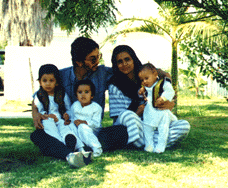
    Shamima learned of her cancer in 1997. She continued her social struggle in the face of her physical struggle against illness, and most would say, with even more zest than before. Her last public engagement in the media was the deliverance of a paper “Women & Islam – The Gender Struggle in South Africa”, in Durban, with great difficulty due to her condition. Just seventeen days later, on January 8, 1998 / 9 Ramadan 1418, Shamima passed away. She left behind her husband Na’eem and two sons Minhaj and Shir’a. May Allah grant her peace and paradise.

    In life, as in death, Shamima fought against what she perceived as injustice, to people of colour, and to women. Numerous funeral prayers were said for her; most notably the funeral prayer led by a woman, her close friend, Farhana Ismail, as per Shamima’s request. Shamima was often referred to by her opposition as “that mad Shaikh women.” At another funeral service in a Johannesburg masjid, led by her husband Na’eem, he prayed, “If this be madness God, give us all the courage to be mad.”

    * Published on the website “Muslimah Media Watch” here

  • Audio

    Shamima Shaikh’s interview on The Voice, a Johannesburg-based community radio station owned by the Muslim Youth Movement. Shamima was a founder of the station, and its chairperson until her death, in January 1998, five months after the station went on air.

    The interview was done by Zaheera Bham in October 1997.

    Shamima Shaikh Interview [1]

    {Soundcloud}https://soundcloud.com/user-943171962/shamima-shaikh-interview-1{/Soundcloud}

    Shamima Shaikh Interview [2]

    {Soundcloud}https://soundcloud.com/user-943171962/shamima-shaikh-interview-2{/Soundcloud}

    Shamima Shaikh Interview [3]

    {Soundcloud}https://soundcloud.com/user-943171962/shamima-shaikh-interview-3{/Soundcloud}

    Shamima Shaikh Interview [4]

    {Soundcloud}https://soundcloud.com/user-943171962/shamima-shaikh-interview-4{/Soundcloud}


  • Cultivating Spirit, Embodying Justice: Sufism, Gender and Islamic Feminism – Sa’diyya Shaikh

    Cultivating Spirit, Embodying Justice: Sufism, Gender and Islamic Feminism – Sa’diyya Shaikh

    The Second Shamima Shaikh Lecture was delivered by Professor Sa’diyya Shaikh, associate professor in the Department of Religious Studies, University of Cape Town. The topic of her lecture was “Cultivating Spirit, Embodying Justice: Sufism, Gender and Islamic Feminism”.

    The lecture event was held in Overport, Durban at the Al-Ansaar Hall, on the 5 September 2015.

    • Programme for Second Shamima Shaikh Memorial Lecture
    • Lecture: “Cultivating Spirit, Embodying Justice: Sufism, Gender and Islamic Feminism”, by Sa’diyya Shaikh.


    See also:

    Second Annual Shamima Shaikh Lecture – Voice of the Cape


  • Narratives of Empowerment: Muslim Women and the Gender Jihad in South Africa

    Narratives of Empowerment: Muslim Women and the Gender Jihad in South Africa

    14317395 10154015654688736 5558448927522645578 nThe Third Shamima Shaikh Memorial Lecture was delivered by Dr Fatima Seedat, lecturer and coordinator of the Gender, Religion and Sexual and Reproductive Health Rights programme at the University of KwaZulu Natal, Durban. Her lecture was entitled “Narratives of Empowerment: Muslim Women and the Gender Jihad in South Africa”.

    The Memorial Lecture event was held at the Bo Kaap Museum Community Hall in Cape Town on the 17 September 2016.


    • Programme for Third Shamima Shaikh Memorial Lecture
    • Lecture: “Narratives of Empowerment: Muslim Women and the Gender Jihad in South Africa”, by Fatima Seedat.


    See also:

    Late Shamima Shaikh honoured at Cape memorial lecture – Al-Qalam

    Shamima Shaikh Commemorative Lecture – Awqaf SA


  • Khadija Patel 2018

    Khadija Patel 2018

    SSlecture2018

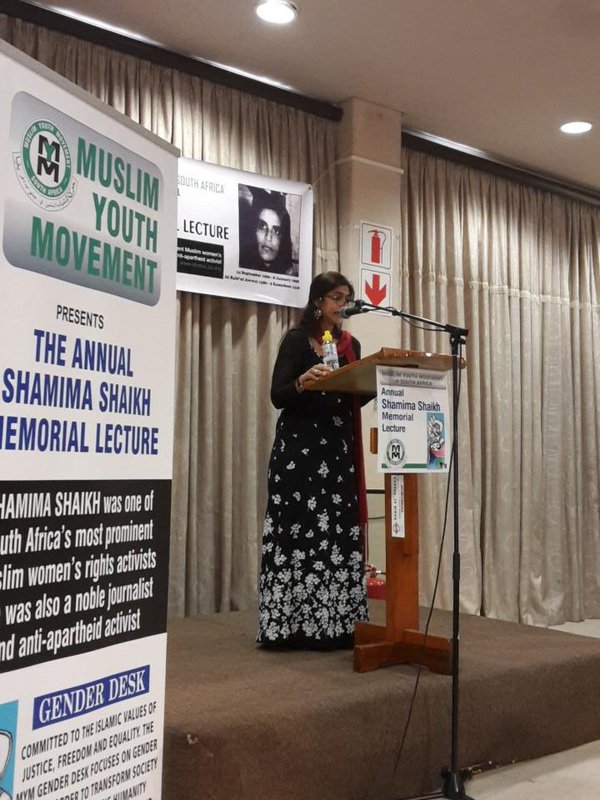
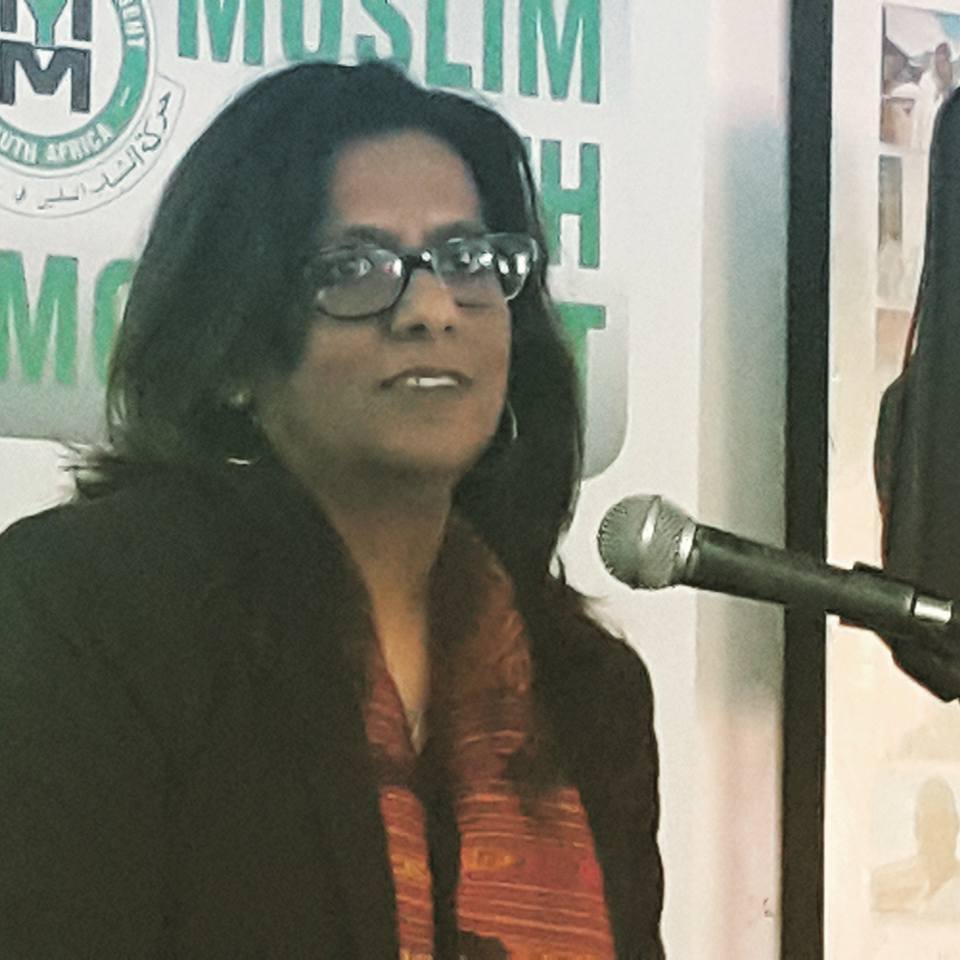
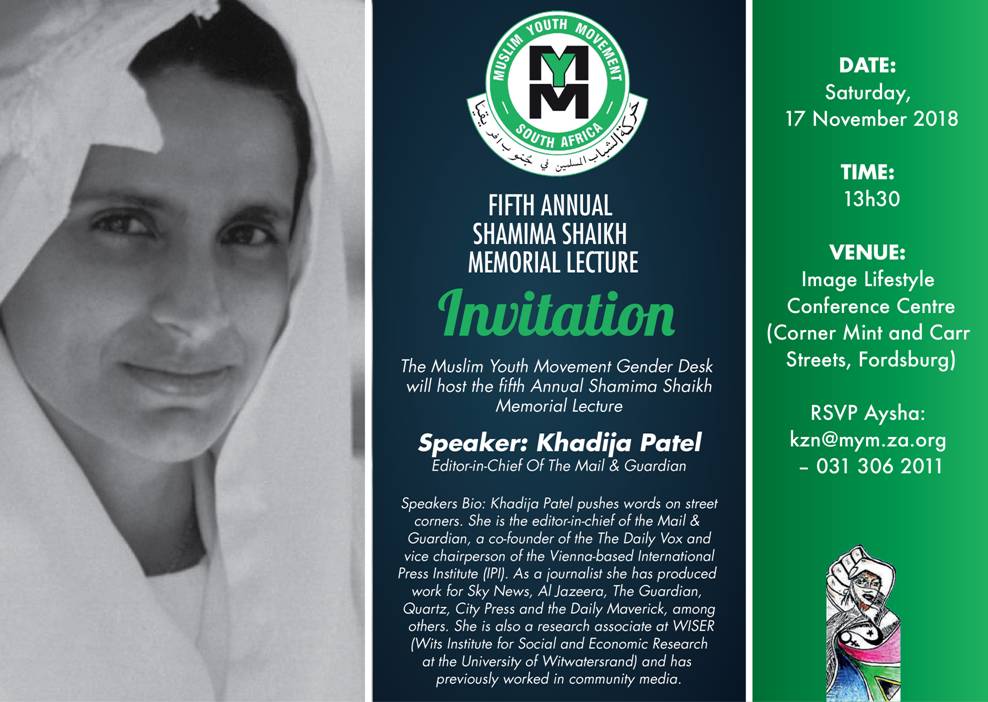
    The Fourth Shamima Shaikh Lecture will be delivered by Khadija Patel, chief editor of the Mail & Guardian, one of South Africa’s most respected newspapers.

    The lecture event will be held at the Image Lifestyle Conference Centre, Fordsburg, Johannesburg on 17 November 2018.

    • Programme for Fourth Shamima Shaikh Memorial Lecture
    • Lecture by Khadija Patel.


  • Muslim Feminism, Islamic Law and the Quest for Gender Justice – Kecia Ali

    Muslim Feminism, Islamic Law and the Quest for Gender Justice – Kecia Ali

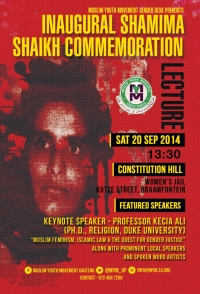
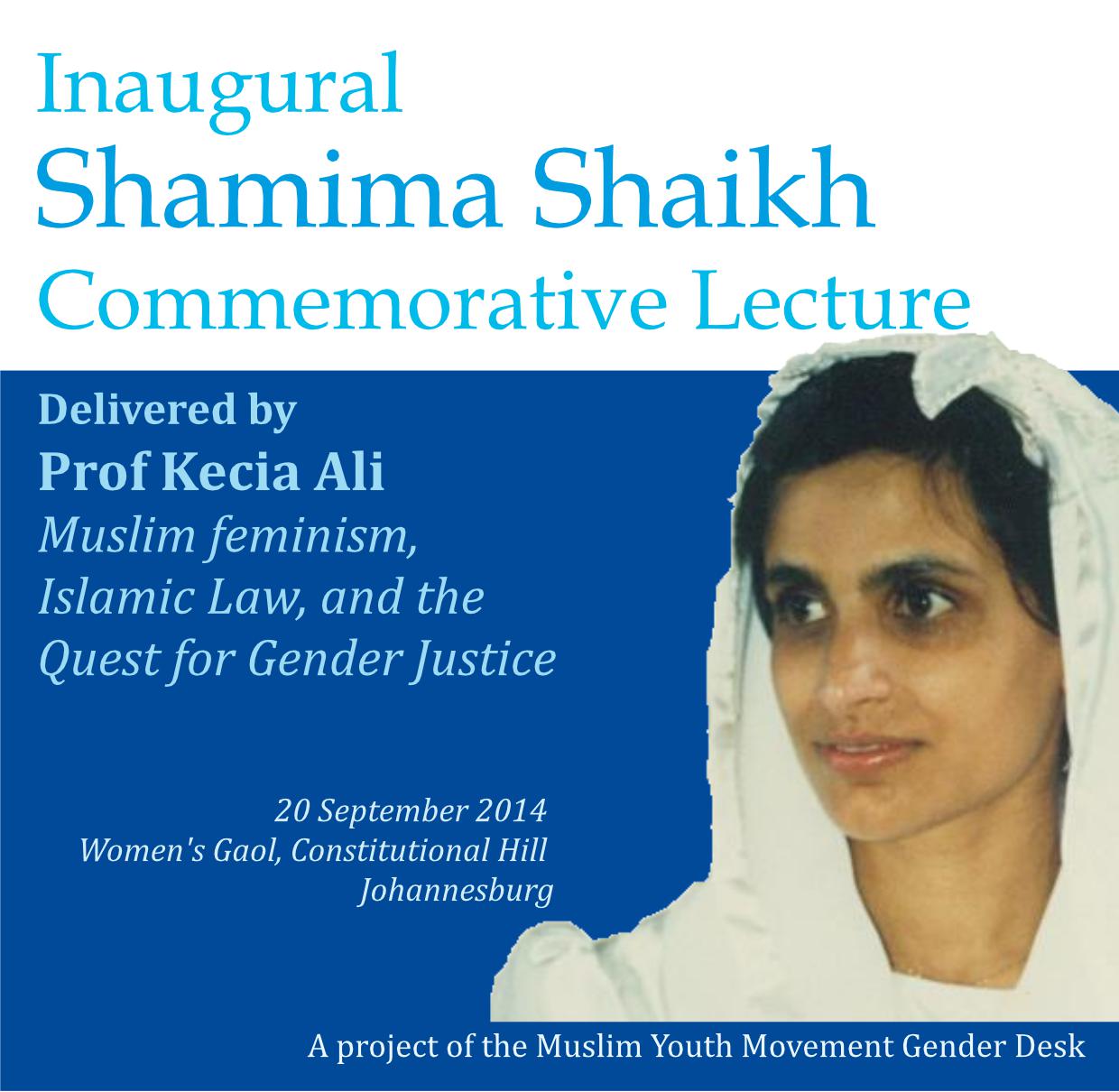
    The inaugural Shamima Shaikh Lecture was delivered by Professor Kecia Ali.

    It was held at the historical – and very symbolic – Women’s Gaol, Constitution Hill, Johannesburg, on 20 September 2014.

    Download Lecture Booklet


    See also:

    Gender Activist Shamima Shaikh Remembered – Voice of the Cape

    Interview with Safiyyah Surtee on the Memorial Lecture – Voice of the Cape


  • The mad courage of Shamima Shaikh’s activism for mosque reform

    , Thursday, 23rd October 2014, in Aquila Style

    http://www.aquila-style.com/focus-points/mightymuslimah/mad-courage-shamima-shaikh/82764/

    How a Muslim woman who fought for gender equality had her sanity questioned in a South African mosque. By Merium Kazmi


    Contrary to popular belief, Islamic history is full of stories of extraordinary Muslim women. These women have assumed positions of power and respect by challenging cultural norms of women’s role in society, and contributing to their communities’ wellbeing and development. These range from the heroic contributions of many female members of the Prophet’s (peace be upon him) family, to philanthropists like Fatima Al Fihri, who in Fez, Morocco built the University of Qarawiyin, the world’s oldest and a UNESCO World Heritage site. Today, we also have strong leaders, such as Atifete Jahjaga, President of Kosovo and also the world’s youngest female president.


    It is unfortunate that at times we learn of these brave women only after they have passed away. For many of us, Shamima Shaikh is one such individual. A Muslim from South Africa of Indian descent, Shamima was a journalist and activist who strived to relay the Qur’an’s messages of peace, justice and equality to both a burgeoning community of fellow Muslims and the politically charged atmosphere of apartheid and post-apartheid South Africa. She became known for the strength and tenacity with which she fought for the rights of women – rights she believed the religion of Islam guaranteed her.

    Her activism traces back to her days at the University of Durban-Westville (initially established for South Africans of Indian descent and now called the University of KwaZulu-Natal), where she studied Arabic and psychology. The university was known for its anti-apartheid political rallies which increasingly matched the socio-political direction of the country at the time.

    Becoming involved with the Azanian People’s Organisation (AZAPO), a black consciousness political organisation, she protested against an oppressive academic environment. Following her collaboration with AZAPO, she had a brief teaching stint, in addition to meeting and marrying her husband, Na’eem Jeenah, a well-known and respected academic and journalist.

    Her indomitable fighting spirit would find a home in an extensive collaboration with the Muslim Youth Movement of South Africa (MYMSA), an organisation focused on serving the Muslim community through initiatives of education, advocacy, socio-economic development and gender justice. She would assume the role of editor of their Muslim monthly, Al-Qalam, and venture into other opportunities with MYMSA, eventually taking on a greater leadership and decision-making role in the organisation as executive chair. She became the second woman to do so in the history of the organisation.

    If this be madness God, give us all the courage to be mad.

    – Na’eem Jeenah, husband of Shamima Shaikh

    One of the many campaigns that Shamima was involved with under the auspices of the MYMSA was the 1989–1990 series of protests against the South African legislative body (the Tricameral Parliament), who were against any political representation for coloured and Indian racial minorities during apartheid.

    She also introduced the Women in the Mosque campaign, and her struggle in this regard would go on to define her work as a women’s rights activist. All of these efforts would culminate in her being appointed the national coordinator of the Gender Desk at MYMSA.

    Her Women in the Mosque campaign was an important part of her advocacy work. On praying at the mosque, she said:

    It is important for women to be at mosques because they are the most important centres of Islam. Decisions are taken, direction is given. It is where people meet to pray together and it promotes consultation.

    The event that would unfortunately label her as “that mad Shaikh woman” took place in 1994 on one of the holiest nights of the year, 27th Ramadan.[i] In the hope of offering tarawih prayers at a Johannesburg mosque, she arrived to find their designated space occupied by male worshippers (as was often the case during crowded gatherings).

    Accompanied by a small group of women from the tents set up outside, Shamima made attempts to reclaim their space, drawing rancour from some community members who considered the presence of women unnecessary. Spurred by this event, she would eventually go on to form an “alternative” congregation that respected gender equality and held other progressive Islamic values.

    Although it came many years before, Shamima’s stand is similar to the efforts being made by the Inclusive Mosque Initiative in the United Kingdom, which hopes to provide a space for all Muslims – young or old, male or female, straight or gay – to pray side by side.[ii]

    As the chairperson of the Muslim Community Broadcasting Trust, she oversaw the establishment of an Islamic radio station, The Voice.[iii] She had learnt of the controversy over the lack of women’s voices on other Islamic radio stations in South Africa and had hoped to correct that by ensuring that voices of Muslims from a variety of backgrounds were heard. She wrote extensively about women in Islam and published a book, Journey of Discovery, with her husband about their experiences performing the Hajj.

    As an Islamic feminist, Shamima joins a growing list of individuals who have defied socio-cultural expectations and remained committed to enhancing the status of women in the region. While the struggle to implement gender-equitable programmes and policies continues today, it is heartening that Shamima’s life story continues to inspire women and girls to embark on their own struggles. Such actions spur discussion, debate, understanding and respect, all of which are necessary to accommodate the ever-growing diversity of Muslim voices in our respective communities.

    Her struggle to achieve gender equality also paralleled her struggle with cancer, which would eventually take her life during Ramadan in 1998 at the age of 37. Even her departure from this world was testament to her faith in the religion of her birth and its inherent promotion of gender equality: her funeral prayers were read by a close female friend, an act unheard of in the Muslim world. This final farewell served as a perfect denouement to a life well lived.[iv] She was laid to rest in the city of her childhood, Pietersburg, and left behind her husband and two sons – as well as a lasting legacy of tenacity for asserting her God-given rights.

    The Shamima Shaikh Commemorative website is a great repository of information for those interested in reading more about her.

    All pictures courtesy of Na’eem Jeenah


    [i] Farid Esack, ‘Death of a Muslim Joan of Arc’, Mail & Guardian, 20 Jan 1998, available here
    [ii] Tamsila Tauquir, ‘Mission to build an alternative mosque’, The Guardian, 7 Aug 2013, available here
    [iii] Maria McCloy, ‘Finding a voice’, Mail & Guardian, 19 Sep 1997, available here
    [iv] Farid Esack, ‘If this be madness…’, Women in Action, Feb 1998, available here

    This article originally appeared in the November 2013 Happy New You Issue of Aquila Style magazine. You can read the entire issue free of charge on your iPad or iPhone at the Apple Newsstand, or on your Android tablet at Google Play


  • A fine example of “Living Islam”

    By Aslam Fataar & Najwa Nordien

    Published in Al-Qalam, December 2000


    “Have yourself a ‘storied’ Ramadan.” This wish by an American friend to us only became meaningful after we read Na’eem Jeenah and Shamima Shaikh’s book Journey of discovery: A South African Hajj.

    The book is an example of a couple’s active mediation of their Hajj journey’s travails, filtered through their identity as young progressive, somewhat irreverent, and always passionate South African Muslims.

    The book fills an important gap in the religious market. It consists of a number of short stories, written with a compelling flow, and each containing a concise, yet deep message.

    We marvel at this couple’s love of life, of each other and of Allah (SWT), which shine through the pages of the book. They are an example of lives lived differently, and pushed to the limits of their consciences and beyond.

    As committed anti-racists and gender activists, the couple engage with those they meet on hajj, the places they visit, and their acts of worship, in search of greater meaning and inspiration. Hajar is creatively portrayed as “Imamah Hajar” in reference to Muslims following in her footsteps in one of the main rituals of hajj.

    Women praying among men in the precincts of the holy mosque in Makkah are a vindication of the authors’ struggle for absolute equality between men and women. The book succeeds in one fundamental respect: it is neither a text about normative Islam, nor a rule book about how to perform the hajj rituals. It is unambiguously a book about “living Islam”, Islam as an unfinished product, of experiencing and experimenting. The journey towards Islam is as important as the fulfilment of the hajj ritual obligations. Their stories suggest a closer relationship between the ideal and the actual, where the two are brought into conversation with each other, leading to a creative and tasteful exercise of faith. Shamima and Na’eem can proclaim their hajj as truly their very own.

    We encourage a quick and thorough reading of the book. Become inspired, and then write your own stories about your “living Islam”.